Showing posts with label Cuban Five. Show all posts

Friday, 7 October 2011

Rene Gonzalez to be released - punishment to continue

Source: RATB.
by Helen Yaffe, 05 October 2011.

On Friday 7 October, Rene Gonzalez, one of the Cuban Five incarcerated in United States since 1998 for combating terrorism against Cuba, faces a ‘supervised release’ under life-threatening conditions. In 2001, Rene was sentenced to 15 years in prison charged with conspiracy to act as a non-registered foreign agent. He had already spent 33 months in ‘preventative custody’, including 17 months in isolation in ‘the hole’.


Rene’s real crime, like that of his co-defendants (Gerardo Hernandez, Antonio Guerro, Ramon Labanino, Fernando Gonzalez), was defending Cuba against acts of terrorism planned, financed and launched by Cuban exile groups in Miami; groups with well documented links to the US government agencies. The conditions imposed by Federal Court Judge Lenard on Friday 26 September 2011, force Rene to reside in Miami for three years, without returning to Cuba to be with his wife (who has been permitted to visit him just once by US authorities) and two children.

Rene was born in the United States in 1956, but returned to Cuba as a child just after the Cuban Revolution in 1961. He became a pilot and flight instructor. Between 1977 and 1979 he was among thousands of Cuban combatants who fought for the national liberation of Angola and against the racist apartheid regime of South Africa. In 1990, at the request of the Cuban government, Rene returned to the United States to gather information in order to prevent terrorist plots against Cuba.

The Cuban Five had no guns and no explosives. They were not after classified information or threatening US national security. They were gathering information and evidence from terrorist networks about actions planned and launched from US soil. In the 1990s more than 200 attacks were launched from Miami, many of them targeting Cuba’s expanding tourist industry. In 1998, Cuba handed the FBI a mountain of evidence compiled by the Cuban agents from the terrorist networks in Miami. That information made it possible to successfully prevent 170 attacks against Cuba, including a plan to blow up aeroplanes filled with Cuba-bound tourists from Europe and Canada. Instead of acting on the information to break the terror networks, the FBI arrested the Cuban agents.

The utter hypocrisy of the US judiciary is emphasised by the conditions established for Rene’s ‘supervised release’, which prohibit him ‘from associating with or visiting specific places where individuals or groups such as terrorists, members of organizations advocating violence, organized crime figures are known to be or frequent.’ In other words, the court can identify where terrorists and criminals hang out in Miami, but rather than arrest and put them on trial, it warns Rene, a US-citizen who has actively opposed terrorism, not to disturb them. So much for the war on terrorism!

Perversely, while warning Rene to stay away from these groups and individuals, the court will not permit him to do the only thing which would secure his safety – return to Cuba. The conditions force him to remain in the same city as the terrorists he was monitoring, where the ‘show trial’ took place, during which journalists were paid by the US government to secure a conviction, and which has a powerful right-wing Cuban exile population. Among Miami’s Cuban exile residents is Luis Posada Carriles, an ex-CIA agent, responsible for bombing a Cuban civilian aeroplane in 1976, killing all 73 persons aboard, and the bombing of hotels and restaurants in Havana in 1997. Carriles recently reaffirmed his support for further violence against Cuba.

‘Why is the Court putting Mr Gonzalez’s safety at risk by forcing him to live for the next three years side by side with the very terrorists that he tailed as an unregistered Cuban agent?’ demands José Pertierra, an attorney representing the Venezuelan government’s extradition case against Carriles.

Terrorism against Cuba has cost the lives of 3,478 Cubans and permanently maimed another 2,099. Rene’s life is at risk if he is forced to remain in Miami. Judge Lenard, who issued the ‘supervised release’ has justified her decision by stating that if Rene returns to Cuba she won’t be able to assess whether the US public ‘will be protected from further crimes of the defendant’. But as Pertierra responds: ‘His only “crime” was failing to register as a foreign agent.’ Absurdly, Judge Lenard also claims more time is needed to ‘provide the defendant with needed educational or vocational training, medical care, or other correctional treatment in the most effective manner’. This is nonsense. Rene has declared his intention to renounce his US citizenship and return to live in Cuba with his family, he does not need to be ‘reintegrated’ into US society. Pertierra adds: ‘As for medical care, he will have access to the best medical care in Cuba and it will be available at no expense to the United States or to himself.’

Judge Lenard’s decision allows Rene to re-file his motion to return to Cuba at a later time ‘should circumstances warrant modification’. Pertierra asks: ‘What circumstances could she be waiting for? For a terrorist to take a potshot at Rene?’

However, for right-wing Cuban-exile community even this ‘supervised release’ is too generous. Miami Republican Congresswoman Ileana Ros-Lehtinen, Chairman of the US Senate’s Foreign Affairs Committee, condemned Rene’s release stating on 3 October that: ‘He has American blood on his hands and dedicated his life to harming our country on behalf of a regime that is a state sponsor of terrorism.’ This from a woman who just weeks ago called for Cuba to be attacked Libya-style; an attack which has so far cost the lives of 50,000 to 60,000 Libyans.

In early September, RATB activists participated in two anti-terrorism events in Havana. The first, on Saturday 10 September, commemorated the 14th anniversary of the murder of Italian tourist Fabio di Celmo, killed in the 1997 explosion at the Copacubana hotel in Havana. Guistino di Celmo, Fabio’s elderly father thanked the Cuban people for remembering his son and complained that, years after the terrorist act which took his son’s life, the US press continues to report the lie that Cuba supports terrorism, while the Cuban Five remain in US prisons for combating terrorism. Magalys Llort, mother of one of the Five, presented Guistino with a plaque in homage to his son made by Gerardo Gonzalez, another one of the Cuban Five.

Two days later, RATB joined thousands of representatives of Cuba’s grassroots organisations, cultural organisations, military, foreign diplomats, foreign students and Cuban workers in a cultural event to honour the Cuban Five, whose poems and letters were put to music. President of Cuba’s National Assembly, Ricardo Alarcon, condemned the conditions imposed on Rene Gonzalez’s ‘supervised release’ and pointed out that the case of the Cuban Five proves the US government is complicit with terrorist groups in Miami.

Rock around the Blockade joins international condemnation of this cruel and unusual punishment meted out to Rene and the Cuban people who are waiting to welcome him home. We demand the full, immediate and unconditional release of the Cuban Five and the trial of those terrorist plotters and supporters in the United States, including all those in US government agencies.

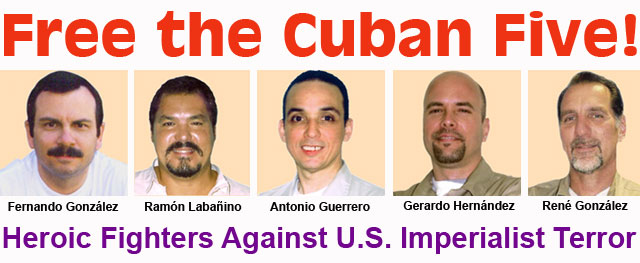
Sunday, 25 September 2011

‘Another terrible injustice’: A message from the Cuban Five on the execution of Troy Davis

Source; National Committee to Free the Cuban Five
by the Cuban Five, 23 September 2011.

The message below was sent by Ramón Labañino on behalf of the Cuban Five. The Cuban Five are political prisoners in the United States, serving four life sentences and 75 years collectively after being falsely convicted of politically motivated criminal charges while monitoring the operations of anti-Cuba terrorist organizations in Miami.
Brothers and sisters: We feel deeply the horrific execution of Troy Davis. It is another terrible injustice and stain on the history of this country. We join in the pain felt by his relatives, friends and brothers across the world. Now we have another cause, another flag, to pursue our struggle for a better world for all, free of the death penalty and barbarism. In Troy’s honor, and all the innocents of the world, we must continue, united, until the final victory! Our most heart-felt condolences!
Five fraternal embraces,
Antonio Guerrero
Fernando González
Gerardo Hernández
René González
Ramón Labañino

Cuba launches campaign for Cuban Five

Source: South Journal, 11 September 2011.

The Cuban people, headed by the youth, kick off a nationwide campaign on Monday for the release of the five Cubans held in US jails for 13 years. The Campaign will run until October 6 and it will include actions not only in Cuba but also in other countries of the world, where people will demand the release of Gerardo Hernández, Ramón Labañino, Antonio Guerrero, Fernando González and René González, known as the Cuban Five.


The initiative´s program includes views exchange, arts exhibitions, galas, an anti-imperialist tribunal, book launchings and other activities to start September 12, marking thirteen years of imprisonment of the Five.

Here a chronicle of the case:
September 1998: five Cubans were arrested in Miami by the FBI and held in punishment cells for 17 months before their case was taken to court. These Cubans were in the United States monitoring Florida-based ultra-right organizations of Cuban origin that had undertaken terrorist actions against Cuba, and even in US territory, over the past 50 years.

The five Cubans named Gerardo Hernandez, Ramon Labañino, Fernando Gonzalez, Antonio Guerrero and René Gonzalez were charged with conspiracy against the United States. Three of them, Gerardo, Ramon and Antonio were also accused of conspiracy to commit espionage. But the US government never asserted that such act was committed. They were never proven to have possessed any classified document. Despite energetic objection by the defense, the case was taken to a court in Miami, a community harboring over half a million Cuban exiles with long hostile records against the Cuban government.

Miami was the environment which, a US federal appeal court described later as “the perfect storm” of prejudices that did not favor a fair trial. And this trial took over six months, being considered the longest such process ever in the United States. Three retired US army generals, a retired admiral, the former advisor to Bill Clinton on Cuban issues testified at the trial and said there was no evidence of espionage. Seven months after the official accusation was issued, a new charge was imposed on Gerardo Hernandez: conspiracy to committee assassination. This was the result of a huge media and public campaign to take revenge for the downing in 1996, by the Cuban air force, of two planes belonging to the Florida-based anti-Castro group “Brothers to the Rescue” and the death in the action of four members of this organization. The Brother to the Rescue planes had illegally entered Cuban airspace 25 times prior to the incident and during 20 months, which led to reiterated protests by the Cuban government.

At the end of the trial, just when the case was almost ready for sentencing, the US administration admitted its failure at proving the charge of conspiracy to commit assassination imposed on Hernandez by saying that in the light of the proofs presented, this would constitute an insurmountable obstacle for the United States in relation to this case and would also result in the failure of the specific accusation. However, the jury found Gerardo Hernandez and the other four Cubans guilty of all charges, following intense pressure by the local media.

The Cuban Five, as these men are known around the world, were given 4 life terms and 77 years. This conviction turned three of them into the first people in the United States to have been given life terms in espionage-related cases, in which there was no evidence of their possession or transfer of any secret document. And then, they were confined to five different high-security prisons, far off from each other and with no communication among them whatsoever.

THE NINE-YEAR LONG APPEAL
 August 9, 2005: A three judge panel with the Atlanta Court of Appeals revoked the court ruling after considering that the Cuban Five were not given a fair trial in Miami. But, the US government requested the rehearing by the Court en banc of the decision reached by the three-judge panel. This procedure is an action that only takes place in cases involving constitutional principles. One year later, the court revoked, by majority, the unanimous decision of the three judges.

May 27, 2005: The United Nations Working Group on Arbitrary Detentions, after having considered the arguments presented by the relatives of the Cuban Five and by the US government, described the convictions as arbitrary and called on Washington to take the necessary measures to correct such decision.

September 2, 2008: Atlanta´s Court of Appeals ratified the guilty verdicts, upheld the convictions against Gerardo Hernandez (two life terms plus 15 years) and against Rene Gonzalez (15 years) while it annulled the sentences against Antonio Guerrero (life term plus 10 years), Fernando Gonzalez (19 years) and Ramon Labañino (life term plus 18 years) for considering them incorrect. So the cases of the three men were sent back to the Miami Court to be resentenced. The Court admitted the absence of any piece of evidence about the possession or transmission of any secret information or related to US national security in the case of the defendants under the charge of conspiracy to committee espionage. Some months later Antonio Guerrero was resentenced to 21 years and 10 months in prison, plus a 5-year parole; Fernando was given 17 years and 9 months in prison; and Ramon 30 years in jail.

June 15, 2009: The US Supreme Court announced, without further details, its decision not to review the case of the five men despite the unquestionable arguments submitted by the defense in the face of evident and countless legal violations committed during the whole process. With this decision, the US justice also turned a deaf ear on the huge world support of this petition and of the Cuban Five, which was openly expressed in 12 amicus curiae documents—an unprecedented action since it has been the largest number of such documents ever filed with the US Supreme Court requesting the revision of a criminal case. The amicus curiae documents were signed by ten Nobel laureates including the president of East Timor, Jose Ramos Horta; Adolfo Perez Esquivel, Rigoberta Menchu, Jose Saramago, Wole Soyinka, Zhores Alferov, Nadine Gordimer, Gunter Grass, Dario Fo and Maired Maguire; the Mexican Senate; Panama´s Parliament; former Irish President, Mary Robinson who was High UN Commissioner for Human Rights (1997-2002), and the former director of UNESCO, Federico Mayor, among others. From the legal point of view the case has concluded. The Cuban Five are now undertaking an extraordinary process, which is known as Habeas Corpus. This is a one-time opportunity of the defendants after all appeal resources have concluded with no success.

In October 2010, Amnesty International issued a report on the case, which read that if the legal appeal process did not yield on-time compensation, and given the long sentences imposed and the term already served by the Five, the organization would support all calls on US authorities to review the case through the proceeding of pardon or any other appropriate ways.


Cuban Five Demand Freedom 
by Teresita Jorge Carpio

The Cuban Five have been victims of an unfair conspiracy after being detained on September 12th 1998 for having infiltrated terrorist organizations based in southern Florida aimed at stopping actions against the Cuban people. Gerardo Hernández, René González, Ramón Labañino, Fernando González and Antonio Guerrero were abruptly striped from their family and submitted to a biased trial in Miami and later sentenced to long unfair prison terms ranging from 15 years to 2 life plus 15 years.

Their defense statements were impressive, sincere and passionate. Tony Guerrero´s defense was poetic stating that they will always defend their principles and cause in their unjust imprisonment. His final words affirm a better future when he said: Because, at the end, we shall rest free and victorious beneath that sun which we are denied today. Rene did not request clemency, but justice for his comrades accused of crimes they did not commit, while Ramon proclaimed: I will wear the prison uniform with the same honor and pride with which a soldier wear his most prized insignias! Fernando concluded by saying: In my years in prison, I always carry with me the dignity I have learned from my people and their history. Gerardo Hernandez was also an example of integrity and dignity when he praised US patriot Nathan Hale saying: My only regret is that I have but one life to give for my country." Love and hope irradiate the letters of these five men that synthesizes a history of value, sacrifice and love as characterized by African American writer Alice Walker.

A phrase by French writer Victor Hugo became their own: "Love, you know, seeks to make happy rather than to be happy." Sweetness and kindness accompany the heroism of the Cuban Five in its incarceration in the dark dungeon, witness of their commitment to the Homeland and their loved ones. To his jewels, as characterized Ramon Labañino to his wife Elizabeth Palmeiro and daughters, he said: Love is the most profound feeling in our lives. Rene Gonzalez, one of the five anti terrorist fighters incarcerated for the last 13 years write to his daughter Ivette: Your good qualities today will turn into virtues tomorrow. In every letter, message or telephone contact, Gerardo, Rene, Ramon Fernando and Tony constantly transmit a message of love and hope.

These five men, characterized by Gail Walker as heroes are dignified heirs of Jose Marti. Homeland is Humanity, said Cuba´s National Hero. They are an international symbol from their prison cells in the fight for peace and for making a reality the desire that a better world is possible. Their loyalty for the Homeland and firmness of the principles are an example for the honest citizens of the world that demand the immediate release of the five giants, as characterized by the leader of the Cuban Revolution Fidel Castro.

Monday, 12 September 2011

RATB reports: solidarity with the Cuban 5 – September 2011

Rock around the Blockade – events in Britain in solidarity with the Cuban 5 – September 2011

On Saturday 10 September, as part of the international days of action for the Cuban 5, on the 13th anniversary of their incarceration in US gaols, members and supporters of Rock around the Blockade in Britain, supported by the Revolutionary Communist Group, held street rallies in four cities: in Glasgow by Donald Dewar Statue, in Newcastle at Grey’s Monument, in Manchester’s Piccadilly Gardens and in Trafalgar Square in London.

We gathered under banners demanding the freedom for the five political prisoners, Gerardo Hernández, Ramón Labañino, Fernando González, Antonio Guerrero and René González, and with petitions, leaflets, flags and placards, with open microphones, speeches and music, we ensured that everyone who passed the stalls understood the significance of the day and the importance of the Cuban 5, the need to build the campaign for their freedom and solidarity with the socialist revolution in Cuba. The Cuban 5 may have exhausted their legal avenues in the US, but the political struggle on the streets all around the world goes on.


Comrades gave speeches in solidarity with the Cuban Revolution and against the US blockade, they talked of the gains made in Cuba, contrasting this with the cuts in public services in Britain in the current economic crisis where health care and education for all are under threat. Speakers raised the issue of the vengeance of the capitalist state against those who pose any threat, as we are witnessing currently in the aftermath of the uprisings in August in cities in Britain. The US and Britain continue shamelessly to use the guise of fighting terrorism while bombing, killing, torturing and incarcerating those who rise up against imperialism. The movement against this oppression must be anti-imperialist, militant and uncompromising. Socialist Cuba and the Cuban 5 are showing the way.

The international days of action for the Cuban 5 have also been marked by Rock around the Blockade with film showings in all these four cities of Saul Landau’s award winning documentary, Will the real terrorist please stand up, released this year which tells the hidden story of 50 years of US terrorism against Cuba, presenting the case of the Cuban 5.

Rock around the Blockade has the following message for the Cuban 5:

‘Dear comrades,

We are writing to you with solidarity on the 13th anniversary of your detention and imprisonment. We organise regular demonstrations, meetings, film showings and solidarity brigades for Cuba because we know that Cuba is a beacon of hope for oppressed people around the world. We know that here in imperialist Britain we have a lot to learn from socialist Cuba and it is the only way to destroy the state and overthrow capitalism. We want to thank you for your continued struggle in the prisons of the US and we want you to know that we take a lot of inspiration from your fight and the continued advances of the Cuban revolution. We are not going to stop until capitalism is destroyed and you are free.

With much love and solidarity,

Rock around the Blockade’

For more information about Rock around the Blockade visit www.ratb.org.uk

Cuba Solidarity campaign joined in with RATB in Manchester, 10 September 2011.
________________________________________________________________________
Rock around the Blockade – Gran Bretana– solidaridad con los Cinco Cubanos - September 2011

El sábado 10 de septiembre, los miembros de Rock around the Blockade y el Grupo Comunista Revolucionario, realizó un evento animada en las calles de Newcastle upon Tyne, Manchester, Glasgow y Londres, Gran Bretana, exigiendo la libertad de los 5 cubanos. Los compañeros dieron discursos en solidaridad con Cuba Socialista, contra el bloqueo de EE.UU. y en contra de la prisión ilegal de los cinco héroes cubanos. Los habitantes se detuvo a firmar peticiones para los 5 cubanos y firmar cartas de solidaridad que han sido enviados a Gerardo Hernández, Ramón Labañino, Fernando González, Antonio Guerrero y René González. La manifestación marcó 13 años desde su detención en Miami y busca destacar el caso de los 5 cubanos y fomentar la solidaridad con la Revolución Socialista Cubana. Rock around the Blockade tiene el siguiente mensaje para los 5 cubanos y sus partidarios


‘Queridos compañeros,

Nos dirigimos a ustedes con la solidaridad en el 13 aniversario de sus detención y encarcelamiento. Se organizan manifestaciones periódicas, reuniones, proyecciones de películas y brigadas de solidaridad de Cuba, porque sabemos que Cuba es un faro de esperanza para los pueblos oprimidos de todo el mundo. Sabemos que aquí en Gran Bretaña imperialista que tenemos mucho que aprender de Cuba socialista y es la única manera de destruir el Estado y derrocar el capitalismo. Queremos darle las gracias por su continu luacha en las cárceles de los EE.UU. y queremos que sepan que tenemos un montón de inspiración de que la lucha continúa y los avances de la revolución cubana. No vamos a dejar de luchar hasta que el capitalismo se destruye y ustedes son libres.

Mucho amor y solidaridad.

Rock around the Blockade’


El fin de semana de acción culmina en una película que muestra de "¿El verdadero terrorista por favor ponerse de pie", un premiado documental lanzado este año cuenta la historia oculta de 50 años de terrorismo estadounidense contra Cuba, al presentar el caso de la Cinco cubanos. Los entrevistados son renombrados terroristas Luis Posada Carriles, Orlando Bosch, José Basulto y otros, que tengan libertad de caminar por la calles de Miami, apoyado y protegido por el gobierno de EE.UU., junto con
imágenes raras de la invasión de Bahía de Cochinos.


Para más información sobre Rock around the Blockade, visita www.ratb.org.uk

Saturday, 27 August 2011

Weekend of action for the Cuban 5!

Over the weekend of 10-11 September 2011, RATB activists across Britain will be organising activities in support of the Cuban 5 as they approach the 13th anniversary of their 'kidnapping' and imprisonment by the US government.

In Manchester on Saturday 10 Sepember, we will be holding a campaign stall with leaflets, petitions and a speak-out in Piccadilly Gardens, city centre starting at 12 noon. The following day we will be showing the new film by Saul Landau, 'Will the Real Terrorist Please Stand Up' in the Cross Street Chapel, Cross Street, starting at 2pm. Make sure you put the film show in your diary, this will be the first time the film has been showed anywhere in the North West.


Free the Cuban 5!
Solidarity With Socialist Cuba!


RATB events you can join in

FREE FILM SHOWINGS

Will the Real Terrorist Please Stand Up (2011, Saul Landau), telling the story of the Cuban Five and a half century of hostile US-Cuban relations.

LONDON
Sunday 4 September, 5pm
The Compass pub, corner of Chapel Market and Penton Street
Angel, Islington, N1

MANCHESTER
Sunday 11 September, 2pm
Cross Street Chapel
Cross Street, M2

NEWCASTLE
Tuesday 13 September, 7pm
Barkollo
22 Leazes Park Road, NE1

GLASGOW
Wednesday 14 September, 7.30pm
Langside Halls,
Shawlands, G4


RALLIES AND PROTESTS FOR THE CUBAN FIVE

LONDON
Saturday 10 September, 12-3pm
In front of the National Gallery. Bring stalls, literature, banners and music.
Trafalgar Square, Central London

MANCHESTER
Saturday 10 September, 12-3pm
Piccadilly Gardens

NEWCASTLE
Saturday 10 September, 12-3pm
Grey’s Monument
Grey Street, NE1

GLASGOW
Sunday 11 September, 1-3pm
Donald Dewar Statue
Buchanan Street, G1

Free the Cuban Five! - Defend the socialist revolution in Cuba

Source: Fight Racism! Fight Imperialism! (FRFI) no. 222, August/September 2011.

by Ali Erkaslan

12 September 2011 will mark 13 years since the arrest in Miami, Florida of five Cuban intelligence agents who had infiltrated right-wing terrorist organisations in the United States to help foil terrorist attacks against the Cuban people. They remain incarcerated in US prisons. The campaign for their release is an essential part of the struggle to defend Cuban socialism. In September, Rock around the Blockade will join activists from around the world demanding the release of the Cuban Five.

Government-funded propaganda operation in Miami exposed - Part 1

Source: Reporters for Hire

by Gloria La Riva

More than 2,200 pages of documents obtained through FOIA

In 1998, five Cuban men were arrested by the U.S. government and tried in Miami on charges of conspiring to commit espionage on the United States.

The five men’s mission was to stop terrorism, keeping watch on Miami’s ultra-right extremists to prevent their violent attacks against Cuba. “The Cuban Five,” as they are now known, were convicted after repeated denials by the judge to move the trial venue out of Miami. The U.S. government insisted that they be tried in Miami.

What the Cuban Five and their attorneys did not know during trial was that the U.S. government—through its official propaganda agency, the Broadcasting Board of Governors—was covertly paying prominent Miami journalists who, at the same time as the government conducted its prosecution, saturated the Miami media with reports that were highly inflammatory and prejudicial to the Cuban Five.

The presence of Miami journalists on the U.S. government payroll, who purported to report as “independent” press, goes to the heart of the unjust conviction of the Five. The Five were not only victims of a politically-motivated prosecution, but a government-funded propaganda operation as well.

Lawrence Wilkerson, chief of staff for Colin Powell when he was Secretary State from 2001 to 2005, commented about the inability of the Cuban Five to receive a fair trial in Miami:

When the case came to trial, a change of venue was warranted and asked for because no Miami court was going to give the Cuban Five a fair trial, since the city is largely in the hands of some of the very Cuban-Americans and their supporters who've allegedly perpetrated these atrocities on the Cuban people and are prepared to invade the island. But the change of venue motion was denied. And of course the five were convicted.

Wilkerson has called for the release of the Cuban Five.

So, too, has former U.S. president Jimmy Carter, who stated:

I believe that there is no reason to keep the Cuban Five imprisoned, there were doubts in the U.S. courts and also among human rights organizations in the world. Now, they have been in prison 12 years and I hope that in the near future they will be released to return home.

Will the Real Terrorist Please Stand Up Indeed!

Source: The Havana Note
by Lawrence Wilkerson, 11 April 2011.

Several nights ago (6 April), I watched “Will the Real Terrorist Please Stand Up” at the West End Cinema in Washington. Six months ago, Saul Landau, the filmmaker, had given me an earlier rough-cut version on DVD that I had watched, but I was not prepared for the final version with all of the added footage gained by Saul’s recent sojourn in Cuba itself and the slap-in-the-face showing on the large screen.

But the added footage from the island and the bigger screen were not all that made the final version more electrifying. It was, all in all, the pro-Cuba aspect of the film that stunned me.

And it was clear that this pro-Cuba aspect was not conjured by the filmmaker but by history. Perhaps, I told myself, I knew much of this history, intellectually, academically. But I had never seen it so graphically put before me, in such a tight, cinematic package that seemed to leap off the screen almost in synch with the beating of my pulse.

The backdrop of the film was the U.S.-Cuba relationship from the 1959 revolution to the present. That relationship was portrayed quite accurately, leaving no doubt why Theodore Roosevelt referred to the island as “that infernal little Cuban Republic” even though TR pre-dated the revolution by a generation-plus. That is chiefly because the one-sided nature of U.S. policy has been the same from 1823 to the present. TR’s remark demonstrated well before the Cuban revolution, well before the dictator Fulgencio Batista, well before the U.S. mob took over Havana, well before Fidel Castro shouted “¡Bastante!” from the Sierra Maestra, well before Jesse Helms displayed his latent racism toward Cubans, just how badly the U.S. had treated its island neighbor since the beginning of our republic. So badly, in fact, that the portrayal of it, however evanescently, by a master filmmaker made one want to weep for his country and its policies. I doubt there was a single person in the audience that night who felt any differently, except perhaps the several Cubans who were present who, indeed, probably wept for el coloso del norte as well but for different reasons.

And then there was the main point, the point embodied in the film’s title.

Clearly shown and vividly documented was the fact that the United States sponsors terrorism. In Posada Carriles and Orlando Bosch alone, there are overtones of Osama bin Laden and Aman al-Zawahiri, the nefarious leadership of al-Qa’ida. In the film, Carriles and Bosch as much as tell us this in their own words. Moreover, they seem to rejoice in it, as they live today undisturbed and unmolested in Miami; indeed, as heroes among the ignorant Batista-like refuse whose mother’s milk sustains them. Neither man has even the redeeming feature of religious asceticism that some would argue gives bin Laden and Zawahiri a grudging respect; instead these two terrorists seem precisely what the film depicts, criminal thugs.

Whether it is bringing down a Cuban airliner with more than 70 people on board—including the young people on the Cuban fencing team—or murdering a young Italian man in a Havana hotel, these terrorists appear to take joy in what they have done, declaring in so many words and facial expressions that such deaths are the collateral damage of war. War? Yes, a war waged from the territory of the United States—the state of Florida primarily—and against another sovereign country. A war that continues to this day with the United States doing almost nothing to stop it and, as the film depicts in subtle ways, from time to time even aiding and abetting the terrorists who are waging it.

Once, of course, the dictates and fears of the Cold War afforded a patina of credibility to this war waged from our own shores and against the laws of our own land. As a U.S. soldier for 31 years, I participated in that twilight struggle most of my professional life, so I understood its demands however imperfectly they were sometimes met. But the Cold War ended almost 20 years ago. Not the case, however, with the undeclared war against Cuba.

Perhaps the best cinematic summary of this reality was rendered in the film by none other than the current chairman of the U.S. House of Representative’s Committee on Foreign Affairs, Ileana Ros-Lehtinen, who declared for all to see and hear that she would welcome the assassination of Fidel Castro. No matter how cynical one may have become, that is an astonishing scene. A U.S. Congresswoman asking for the murder of another country’s leader—a most egregious, unbelievable demonstration of this undeclared war with Cuba.

Most vividly and disconcertingly, however, the film goes on to portray this continuing illegal war through the case of the Cuban Five. These are the five Cuban intelligence agents who, in the 1990s, were dispatched to Florida to help the government in Havana defend itself better in this undeclared war.

We know a little of their story. After infiltrating the Cuban-American terrorists ranks in Florida, they accumulated information about planned terrorist activities against Cuba. Alarmed at what they learned, they informed their government in Havana. That government, itself now alarmed, confided in the FBI, hoping that that law enforcement organization would act on the evidence thus accumulated and break up the terrorists ranks in Florida. Instead, the FBI—no doubt at the prompting of the White House—used the information to identify the five Cuban agents, then arrested them. Afterward they were tried in a Miami Court—like trying an Israeli spy apprehended in Iran in a Tehran court. Surprise, surprise, the Cuban Five were not only convicted, twelve years later they are still rotting in U.S. federal prison with the “worst” of them having been awarded two life sentences-plus.

At the very worst, these five Cubans were “foreign agents operating on U.S. soil”, an offense warranting 18 months in jail under U.S. law. As the film makes quite clear, however, usual U.S. practice—for Russians like Anna Chapman, e.g.—is deportation. Instead, these men still languish in jail. Perhaps had they been sexy, provocative women...?

When the film ended and the short, crisp vignettes came on, interspersed among the film’s credits, the main points were hammered home adroitly by some of the film’s principal characters.

As these characters summed up from the screen, I don’t believe there was any doubt in anyone’s mind in that audience—Cuban or American—who the “real terrorist” in the U.S.-Cuba relationship actually is.

The question that had to be buzzing around in everyone’s mind, however, as they walked out of the theater—again, Cuban and American—was what to do about it?

Just like the failure to close the U.S. prison at Guantánamo Bay, the extension of the draconian provisions of “the national security cover-up” methodology in courtroom after courtroom across America, the civil liberties-usurping parts of the Patriot Act, the military tribunals for the likes of Khaled sheik-Mohammad, and on and on in the litany of dangerous and illegal acts by the U.S. Government in the name of perfect security and corrupt, special interest politics, the affair of the Cuban Five, and all it represents about the U.S.-Cuba relationship, stains the very fabric of our democratic republic.

Recently, a long-serving veteran of the CIA wrote a heavily-redacted yet still extremely eloquent and convincing memoir of his days in that agency, days that included the most intense period of our so-called Global War on Terror during the George W. Bush administrations. Here is one of his final conclusions in that memoir:

“I saw that a few of our leaders, in their insularity and sanctimonious certainty, corrupted the laws and started to corrode our social compact. We can take actions, however, to diminish such men, and that reaffirm our society’s commitment to our principles, our institutions, and the rule of law.”

That is the answer to our question and Saul Landau has taken a powerful action.

Colonel, US Army (Retired) Lawrence Wilkerson is the Visiting Pamela C. Harriman Professor of Government at the College of William Mary, as well as Professorial Lecturer in the Honors Program at the George Washington University. His last positions in government were as Secretary of State Colin Powell's Chief of Staff (2002-05), Associate Director of the State Department's Policy Planning staff under the directorship of Ambassador Richard N. Haass, and member of that staff responsible for East Asia and the Pacific, political-military and legislative affairs (2001-02). Before serving at the State Department, Wilkerson served 31 years in the U.S. Army, including as Deputy Executive Officer to then-General Colin Powell when he commanded the U.S. Army Forces Command (1989), Special Assistant to General Powell when he was Chairman of the Joint Chiefs of Staff (1989-93), and as Director and Deputy Director of the U.S. Marine Corps War College at Quantico, Virginia (1993-97). Wilkerson retired from active service in 1997 and then worked as an advisor to General Powell.

Friday, 15 July 2011

Ricardo Alarcón Launches New Book on the Cuban Five

Source: Cuba News Agency (ACN), 14 July 2011.

The president of the Cuban National Assembly (Parliament), Ricardo Alarcón, participated on Wednesday in Havana in the launch of a new book on the five Cuban antiterrorists who remain unjustly imprisoned in the United States since 1998.

‘Forbidden Heroes: The Untold Story of the Cuban Five’ is a compilation of 16 articles written by Alarcon, which were previously published by CounterPunch magazine.

The book was launched at the venue of the Association of Cuban Writers and Artists (UNEAC) in Havana with the presence of intellectuals and relatives of Gerardo Hernandez, Ramon Labañino, Antonio Guerrero, Fernando Gonzalez and Rene Gonzalez —internationally known as the Cuban Five—, who were arrested and given harsh sentences for monitoring anti-Cuba extreme right-wing groups in South Florida that were planning and carrying out terrorist actions against the Caribbean nation.


In these texts, Alarcón exposes solid arguments and evidence of the responsibility of the U.S. Government not only in trying to silence this unjust case, but also in trying to promote terrorism against Cuba and to protect those who plan and carry out such actions.

“One after another, we have run out of options to release them through court action. A writ of habeas corpus is all that is left,” said the president of the Cuban legislative body.

“In order to free them, we need to mobilize many people, a ‘jury of millions’ as Gerardo has called it,” Alarcón noted. “The full innocence of our comrades is explicit in the official records of the U.S. Government and courts,” he pointed out.

Thursday, 23 June 2011

US media blockade of the Cuban 5

The Latest Example of the Media Blockade of the Cuban 5
Source: International Committee for the Freedom of the Cuban 5, 23 June 2011.

We were more than a little surprised when a CNN journalist based in Los Angeles contacted SPARC Gallery interested in covering Gerardo Hernandez’s exhibit “Humor from my Pen” before its opening on June 4. We remained skeptical but after several phone calls back and forth an interview was set up.

On June 3 the CNN journalist arrived early to set up her camera and to go over what she would be covering about the background of Gerardo’s work and the case of the Cuban 5 in general.

She seemed genuinely interested and did a long interview with the organizers from the International Committee for the Freedom of the Cuban 5 in both Spanish and English. She also interviewed the Executive Director of SPARC, Debra Padilla.

We did not know going into the interview just how much the journalist knew about the case of the Cuban 5 but after more than 3 hours she learned not only about the artistic talents displayed in Gerardo’s cartoons but also about the deep injustice that he and his four brothers have been enduring for 13 years for defending their country, Cuba, against terrorism.

We asked the journalist how long it would take before we would know if the interview was going to be aired and she told us she did not know but mentioned that her editor wanted to find someone with a different “point of view” to “balance” the story.

This other “point of view” is really the only view that the people of the US are fed on a daily basis when it comes to any topic related to Cuba. That view is a steady stream of vilification, distortion and dishonest reporting of the realities of Cuba living under a 50 year blockade. Despite this we were reminded of what one of the Cuban 5 has said to us on many occasions, “It is better to have bad coverage than no coverage at all”

Our surprise about the interview was even greater when we were told that the “balanced” segment was complete and going to be aired on a program of CNN called “Encuentro” on Wednesday June 15 at 2pm PST.

We immediately passed this new information along to many of our friends so they could see with their own eyes that after 13 years of silence we were going to get a little break on coverage of the Cuban 5.

Unfortunately it did not happen.

The best answer we were able to get from the journalist who did the interview was that it was an “executive decision” not to air the segment.

So many times we hear about freedom in the United States with a free media that covers all points of views; but in the end it is those at the top of the media chain of command who will determine what is news and what isn’t.

Perhaps CNN was having trouble glossing over the courage of the Cuban 5 in the war against terrorism, or to show them in a human light. Perhaps they could not find a way to deny that these sons of Cuba were extraordinary men sent to Miami to defend the sovereignty of their country. Or maybe they were nervous about the absolute double standard in the US where an admitted terrorist like Luis Posada Carriles can show his paintings in Miami while the Cuban 5, who were here to prevent terrorism, produce art behind bars.

Sunday, 29 May 2011

The Case of the Cuban Five and the Media

Source: CubaDebate
Translation: by Machetera and Tlaxcala

by Ricardo Alarcón de Quesada, May 3, 2011

When the U.S. Government rejected Gerardo Hernández Nordelo’s Habeas Corpus petition on April 25, it did so very categorically, without leaving any margin of doubt. Washington wants the court in Miami to declare his petition inadmissible and to do so summarily, without holding a hearing to examine its merits, without hearing Gerardo, without presenting the evidence it is hiding. This is how it responded to the last legal recourse of a human being sentenced to two life terms plus 15 years.

Washington asked for the appeals for Antonio Guerrero and René González to be dismissed in a similar manner.

These are three practically simultaneous actions that reveal the profoundly arbitrary and unjust nature of the U.S. system. They took place one week ago but have not become news, save for the mentions in our media.

The media dictatorship is probably currently the most efficient instrument in imperialism’s political hegemony. It largely dominates information on a global scale, determining what people are allowed to know and blocking whatever it wishes to conceal, with an iron fist.

The battle for the freedom of our Five compatriots can only be won if we understand this essential fact in today’s world, and are capable of acting accordingly.

Such iron-clad censorship is not accidental. Part of Gerardo’s appeal is based precisely on the concealment of evidence and the perverse function of the so-called information media.

It has to do with a case that practically no-one outside of Miami is aware of. The great media corporations imposed total silence toward the outside world while their correspondents in that city joined with the local media with their dubious reputation, in order to unleash a virulent campaign against the accused which contributed to creating what three judges from the Court of Appeals described as a “perfect storm” of prejudice and hostility, on which basis they decided to dismiss the trial.

Judge Lenard herself repeatedly protested the provocative actions that these supposed journalists were carrying out which created fear among the jurors who felt threatened.

In 2006 it was revealed that these provocateurs had received payments from the U.S. government to perform their dirty work. Since that date, various organizations in the United States have called on Washington to turn over the data it is hiding regarding the reach of the conspiracy whose existence is more than sufficient to prove the scandalous prevarication of the authorities.

For five years, those friends in the U.S. have engaged in efforts as noble as they are lonely, which have been completely unreported by the corporate media and very little has filtered out through those who consider themselves their alternative.

And so it has not been difficult for the U.S. government to maintain its obstinate position and continue imposing secrecy.

Nor has it found it particularly difficult to keep the satellite imagery it jealously guards from public view about the incident of February 24, 1996. Fifteen years ago it did not allow the investigators from the International Civil Aviation Organization to view them, it refused to present them to the court in Miami, and now it has reiterated its refusal. Its attitude of impeding others from seeing the proof that only Washington can access is so obvious and suspicious that in its lengthy 123 page argument with three appendices against Gerardo, it barely alludes to the matter in a twisted five line paragraph.

Allow me a brief review. Gerardo Hernández Nordelo had absolutely nothing to do with the downing of the aircraft on February 24, 1996. The U.S. government itself, that of W. Bush, acknowledged the lack of proof to sustain its accusation against Gerardo and asked to withdraw it at the last minute. It did so in an official document, titled “Emergency Petition” and which, according to they themselves, constituted an unprecedented action in the history of that country.

Here is the document, dated May 25, 2001, soon it will be ten years old, but as far as those who call themselves “information media” it does not exist. I have inherited a certain tendency toward obstinacy from my Andalucian ancestors, and that’s why I carry it with me from time to time, because even gypsies believe in chance. You never know. Maybe one day someone will discover that this document exists.

Returning to the event of February 24, 1996. No U.S. court had jurisdiction over the matter, unless it had occurred in international airspace. The investigation performed by the ICAO revealed something surprising. Despite being warned beforehand by their government, the U.S. radar stations either did not register the event or offered contradictory data or destroyed the data. The only proof supplied by U.S. authorities is the testimony from the captain of a boat that operated – by coincidence? – out of Miami.

And so, the interest, first by the ICAO and later by Gerardo’s defense team, in the satellite imagery. The U.S. government never denied the existence of these images, it admitted having them, but it put a fifteen year prohibition on allowing anyone else to see them.

How can it be explained that they have successfully managed to hide them for such a long time? Simply because their revealing conduct has never become news, because they have been able to count on the complicity of the enormous media corporations, but also, it must be said, on our own laziness.

The worst enemy of press freedom is the media dictatorship exercised by the huge corporations which manipulate information and substitute an industry of deceit.

This dictatorship imposes the news menu that circulates through our newsrooms, its codes of language and interpretation circulating along with it. If we wish to develop truthful journalism, capable of transforming itself into a real alternative, it’s essential to go beyond the menu and find the truth in other sources. It is a professional necessity but also a duty of solidarity with those who, lacking resources, are waging hard battles alone. Assisting in the articulation of their scattered efforts is the obligation of a revolutionary press. It’s also the best recipe for curing the infection from those codes that circulate, often inadvertently, among ourselves.

Acting this way, we can also make news. Without inventing it or fabricating it, like the inventions and fabrications that are so abundant on the menu we are served day and night. By breaking the chains that lock up the truths such as those I’ve allowed myself to mention here. We ought to be, finally, like Julio Antonio Mella wanted us to be: “Thinking beings not driven ones.”

Text read as part of a speech given on May 3, 2011, in an event held jointly by the FELAP (Latin American Federation of Journalists) and the UPEC (Cuban Association of Journalists) for Día de la Libertad de Prensa [Press Freedom Day].

Happy birthday Gerardo and Ramón!

Source: National Committee to Free the Cuban Five

Send a birthday greeting to: Gerardo Hernández and Ramón Labañino!

Gerardo and Ramón have birthdays in June.

Be sure to send them a birthday greeting!

You can write to them directly at the prison, (address below) and also transmit a greeting to our email address below. We will then mail Ramón and Gerardo your greeting which you e-mail us.

Gerardo Hernández was born June 4, 1965.
His address is:
Gerardo Hernández, #58739-004
U.S.P. Victorville
P.O. Box 5300
Adelanto, CA 92301
Ramón Labañino was born June 9, 1963.
He is registered in prison as Luis Medina, so you
have to address the envelope as:
Luis Medina, #58734-004
F.C.I. Jesup
2680 301 South
Jesup, GA 31599
Then inside the cards and letters, you can write to him as Ramón.

Much has happened in the last year, in the struggle for the Cuban Five. Gerardo's habeas corpus appeal is currently underway. His attorneys will file a reply in July to the government's response to his appeal memorandum.

Ramón's habeas corpus appeal memorandum will be filed soon. Antonio Guerrero's appeals are also currently in process. In the meantime, you can read the latest developments on the mobilizing efforts for the Five Cuban Heroes, as well as their legal appeals.


Contact Us
email: info[at]freethefive.org, phone: 415-821-6545

Monday, 2 May 2011

Washington hides proof of innocence of Cuban antiterrorists

Source: Prensa Latina, 02 May 2011.

Washington continues to hide the evidence exposing its corruption in the case of five Cuban antiterrorists imprisoned in that country, and uses its media dictatorship to do so, charged Ricardo Alarcon, president of the Cuban Parliament.

During an International Union Solidarity Conference, at Havana's International Convention Center, the Cuban leader urged the 900 guests from 42 countries to redouble their fight in a battle for life, and against secrecy and infamy.

"A year ago I told you about the situation of the Five, and I explained about the collateral or habeas corpus appeal to be filed on behalf of the fighter Gerardo Hernandez, an innocent young man weighed down by two life sentences plus 15 years in prison," said Alarcon.

Exactly one week ago, prosecutors, meaning Washington, asked the Miami court to summarily rejected the motion without granting a hearing to discuss it, without reviewing the new evidence and arguments, and without allowing Gerardo to appear in court, Alarcon explained.

The corporate media has not said a word about this unjust action by Washington, protected by the total silence of the media and behind the back of public opinion, the parliament leader noted.

Gerardo Hernandez, along with Rene Gonzalez, Antonio Guerrero, Fernando Gonzalez and Ramon Labañino, are serving long sentences for alerting Cuba to subversive plans hatched in southern Florida.

The U.S. government has also refused for 15 years to submit its satellite images of the February 24, 1996, incident around which the farce of a trial revolved, Alarcon noted.

That refusal can only be explained with an obvious statement: the incident occurred over Cuban territory and therefore the Miami court had no jurisdiction.

The president of the National Assembly of the People's Power urged the international solidarity movement to persevere in its struggle to defeat a government that is supported by lies and prevents the U.S. people from discovering the reality.

Friday, 15 April 2011

Cuba denounces US acquittal of terrorist Carriles at the UN

UN: Cuba Denounces US Acquittal of Terrorist.
Source: Cubaminrex-Prensa Latina, 12 April 2011.

Cuba requested the UN on Monday [April 11, 2011] to distribute as an official UN document a note addressed to UN Secretary General Ban Ki-moon by Cuba's Foreign Ministry condemning the acquittal of terrorist Luis Posada Carriles in a judicial farce in the United States.

In a press release, the Cuban Permanent Mission to the UN said that after three months of judicial farce in Texas, it took only three hours for the jury to find the notorious international terrorist not guilty.

Posada Carriles was acquitted from 11 charges of perjury, immigration fraud and obstruction of procedure, all risible accusations compared to the magnitude of his terrorist actions, including the bombing of a Cuban plane, killing all 73 people on board, in 1976 and his involvement in a
series of bomb attacks in Havana in 1997, said the note.

As Posada is acquitted, five anti-terrorist Cuban fighters are unfairly serving a collective 99-year sentence, plus two life sentences, in US prisons for informing on the plans of violent actions against Cuba conceived by terrorist groups based in U.S. territory, added the text.

During the past 12 years, Gerardo Hernandez, Antonio Guerrero, Fernando Gonzalez, Ramon Labanino and Rene Gonzalez, also known as The Cuban Five, have suffered inhuman, humiliating treatment in US prisons.

Posada Carriles' acquittal is an insult to the children without fathers, the widows and the mothers crying for the trail of death left by this terrorist, said the Cuban note.

The Cuban Foreign Ministry said that what happened in El Paso is a shame as it contradicts the US much-trumpeted war on terror, which has triggered military interventions and claimed thousands of lives in other countries.

The note wondered if Washington will be able to open another legal procedure against Posada Carriles for terrorism or proceed to his extradition to Venezuela, as requested over five years ago.

It said that the United States has the obligation by law to agree to this request as it is a signatory of international agreements in this regard and in compliance with UN Security Council resolution 1373 (2001).

Wednesday, 13 April 2011

CubaDebate's new website in English

Cubadebate opens its new Web page in English

With versions of Fidel Castro’s Reflections, El Paso Diary of José Pertierra, exclusive materials from Cuba’s Reasons series and news articles about various national and international themes, Cubadebate opens today [Mar 22nd, 2011 ] its Web page in English that you can find at:

http://en.cubadebate.cu

Of course, it will be always updated with information about the Cuban Five that are in jail in the United States, and the world wide solidarity for the freedom of these fighters against terrorism, that already have more than 12 years in prison after a judgment marred of irregularities and injustices in Miami.

This is the first of a series of blogs in many languages, at least 8, which we will publish in the next days, as beginning of the redesign of our Web site, public on the Internet since august 5th, 2003.

Although it is not a mimetic mirror of the Web site in Spanish, the English version of Cubadebate reproduces some of our most popular sections and the services for the Web 2.0, with its own channels on Facebook and Twitter, also it will keep opened its pages for the visitor’s opinions.


Fidel’s Reflections http://en.cubadebate.cu/category/reflections-fidel/
El Paso Diary http://en.cubadebate.cu/category/series/el-paso-diary/
Cuba’s Reasons http://en.cubadebate.cu/category/series/cubas-reason/
The Cuban Five http://en.cubadebate.cu/category/series/cuban-five/

Also the Twitter

And the Facebook

http://www.facebook.com/cubadebate.en

Tuesday, 5 April 2011

Former US President Jimmy Carter reports on his trip to Cuba

Trip Report by Former U.S. President Jimmy Carter to Cuba, March 28-30, 2011.
Source: Carter Centre, April 1, 2011

At the invitation of President Raul Castro, Rosalynn and I visited Havana on behalf of The Carter Center, accompanied by John Hardman, Jennifer McCoy, Robert Pastor, Melissa Montgomery, John Moores, and Diane Rosenberg.

Saturday, 2 April 2011

Interview with former US President, Jimmy Carter, by Arleen Rodríguez Derivet, Cuban Television journalist

Source: NATIONAL COMMITTEE TO FREE THE CUBAN FIVE
Mar. 30, 2011, Reprinted from CubaDebate
Translation by Machetera.


"I have been informed by officials, for instance, that the shooting down of the small plane[s] over Havana, that caused the death of two pilots, was done after the President of the United States informed Cuban leaders that no more flights would take place. And I was informed by Cuban officials that they notified the President of the United States very clearly, that they could not permit a plane to fly over their capital city...dropping leaflets...but that they would protect the sovereignty of Cuba. So even those more serious allegations, in my opinion, are very doubtful, about their need or cause of the extensive sentences that have been granted to one of the prisoners. So in every way, in my private report with Obama when I return to the United States, in my public statements like today, in my previous conversations with American leaders, I've called for the release of the Cuban Five. One of the reasons is that, guilty or not, they've served a long prison sentence already, more than 12 years, and the fact that they've been punished adequately, even if they are guilty." - Jimmy Carter

Arleen Rodríguez: Hello! A greeting to all of those who are watching Cuban Television right now. I welcome all of you, along with the former President of the United States, James Carter, who just moments before leaving to return to his country has graciously agreed to give us an interview, and an exclusive statement for our television broadcast.

Welcome. Thank you for accepting our invitation

Jimmy Carter: It's a great pleasure to return to Cuba, to Havana.

Rodríguez: It's a great pleasure to have you here as well. You told me that you'd like to say something to the Cuban people before our interview.

Carter: Yes.

Rodríguez: The camera is yours.

Former US President Jimmy Carter's press conference in Cuba

PRESS CONFERENCE BY JIMMY CARTER IN HAVANA

Source: South Journal, 31 March 2011.

Before concluding his three-day visit to Cuba, Jimmy Carter gave a press conference about his agenda on the island, of which we bring you a wrap-up next:


In his introductory statement he said that when he was in office he did all possible efforts to improve diplomatic links between the United States and Cuba. He said he lifted all Cuba-travel restrictions for US citizens and along with Fidel Castro he worked in the setting up of interest sections both in Washington and Havana.

Carter said the US commercial “embargo” on Cuba should be lifted immediately as well as the limitations on US citizens to travel to Cuba and vice versa. He said he wanted to learn about the upcoming Communist Party Congress, to be held in April and that he has been given information on the future plans for Cuba.


He told the reporters that he had met with President Raul Castro and with Fidel Castro, whom he saw enjoying good health; he also met with some groups that criticize the Cuban government and he added he hoped that some of their complaints will receive a response from the Cuban authorities in the future.

As to the case of the five Cubans incarcerated in the United States since 1998, the former US president said that their imprisonment has no sense since American courts have shared doubts about it, as have human rights organizations around the world. They have been in jail for 12 years now, he said and added he hoped that they can be released in the near future. Carter also met with two of the mothers and three of the wives of the Cubans imprisoned in the U.S.

He explained that on Wednesday morning he was able to meet with Alan Gross, a man he thinks is innocent of posing a serious threat to the Cuban people and government and that Gross was sentenced to a long prison term. He said he hoped he will soon be released too.

Carter stressed that there are many things both countries can do to improve relations and have normal links in all possible ways. And he reiterated his gratitude to Raul Castro and other government officials for having allowed him to visit and talk with them.

During the Q/A Session Carter replied to an AP question about the possibility that he could take Alan Gross back to the U.S. with him and if he considered that an exchange of Gross for the five Cuban was possible. In this regard, Carter said he had not traveled to Cuba to coordinate any kind of exchange and that the cases of Gross and the Five are different and must not be related. He considered that Gross should be released because he is innocent—Carter explained—and that the five Cubans should also be freed because they have already been 12 years in prison. In the case of Gross, Carter said an appeal would follow or a possible executive order could be given in the future to release him on humanitarian grounds. His daughter is very sick, while he has lost other family members, said Carter. But he did not expect to take Gross back home with him he said and recalled that Cuban officials had made it clear before he left the United States that Gross would not be released.

Responding to a question by Associated Press Television about a meeting with Obama after this trip to Cuba, Jimmy Carter explained that he will do so to express his opinion he gave the press and about other confidential issues.

Referring to what each country could do to improve relations, Carter said he wished that US travel restrictions to Cuba be lifted as well as limitations on the transfer of humanitarian funds to Cuba. He recalled some meetings with members of the diplomatic community in Havana who said they have found it quite difficult, over the past two years, to bring humanitarian aid to the Cuban people through normal channels because the United States limits the transfers. This was also corroborated by European Union leaders, and this lifting of restrictions could be immediately done by the President of the United States, Carter noted.

He also said he wished to see the complete abolishment of the Helms-Burton Law because in his opinion the approval and signing of it by former President Bill Clinton was a serious mistake.

As to other actions, Carter hopes that Mr. Gross be released and that the five Cubans return home. Any effort on the part of the United States aimed at improving the life of the Cuban people based on financial assistance or other means is a suspicious act, according to the Helms-Burton law, because the legislation is aimed at putting an end to the “Castro regime”. In his opinion that law is counterproductive because when he was president he could do anything he wanted with respect to the travel restrictions and the reestablishment of relations.

As to the congress people of Cuban descent he said they are acting in a very counterproductive manner by trying to blame or punish the Cuban government, when in fact they are punishing the people of Cuba by backing these restrictions.

To the question that if he would agree to be a mediator between the two countries, Carter replied that there is slight chance that he can be asked that kind of service, though he would be happy to help.

Carter also told reporters that he believed Cuba should be taken out of the US list of countries sponsoring terrorism. He said he has learned about a close cooperation between Cuban and US intelligence services to fight threats by Al Qaida and other organizations in the gulf region. The only allegations made by the United States against the Cuban government are related to some groups in Colombia like the FARC and ETA from Spain. But such allegations about Cuba sponsoring terrorism have no grounds so the US President could put Cuba out of the list.

And responding to BBC if he tackled issues like the freedom of expression, the freedom to travel, the economic changes to be analyzed by the upcoming Communist Party Congress, during his meetings with Raul Castro and leader Fidel Castro, Jimmy Carter recalled that when he visited Cuba nine years ago he addressed the people on TV and on the radio and that the Granma newspaper published his statements just as he made them, which expressed his wish about those topics and carried his recommendations.

He said that although he was not very familiar with the details or aspects of the text to be analyzed by the Communist Party Congress, he was informed that some 8 million Cubans gave their opinions on the document. Carter added that the Cuban foreign minister told him that thousands of amendments proposed to the text and that over 65 percent of the paragraphs had been modified on the basis of such proposals.

Finally, Carter said that the members of “dissident groups” he met in the morning told him that many of them had abstained from expressing any requests on personal liberties, because they did not want to be linked to the procedure, since they are in disagreement with its integrality. While others did express their requests, though he said he was not familiarized with the document or with what is trying to be achieved.

Sunday, 27 March 2011

Leonard Weinglass, ¡Presente!

by Gloria La Riva, Coordinator, National Committee to Free the Cuban Five, March 23, 2011.

Leonard Weinglass (in 2006): Aug. 27, 1933 - Mar. 23, 2011

'True justice was his passion and his life.'

Leonard Weinglass, preeminent civil rights attorney and fighter for justice whose defense history includes the Chicago 8, Daniel Ellsberg, Mumia Abu-Jamal and the Cuban Five, died on March 23 of cancer.

Known as Len to all, the last picture taken of him was in hospital several days ago as he reviewed his latest appeals documents for Antonio Guerrero of the Cuban Five, for whom he was official appeals attorney. Weinglass was instrumental in the overall case of the Five, especially the latest appeal of Gerardo Hernández, who is serving an unjust double life sentence for defending Cuba-along with his four brothers-from U.S.-backed terrorism. Weinglass joined the Cuban Five's case in the appeals phase in 2002.

Born August 27, 1933, in New York City, Weinglass earned his law degree from Yale University in 1958. After serving in the U.S. Air Force as a judge advocate, he entered civilian life as a lawyer in an era framed by the great African American Civil Rights movement and the struggle against the Vietnam war. Many of those activists would come to depend on Weinglass to win justice and freedom.

He earned a well-deserved reputation as a people's defense lawyer, the kind of attorney who does not separate his political and personal life from his legal career.

Weinglass's long history of defending political and death-row cases attests to those principles:

  • radical activist Angela Davis in 1973;
  • eight Vietnamese students who faced deportation in 1974 due to their political activities against the war;
  • the Atmore-Holman Brothers in Alabama prison in 1977;
  • Daniel Ellsberg, Pentagon Papers defendant in 1970;
  • Juan Segarra Palmer, Puerto Rican independentista in the Hartford 15 case in 1989; and too many more to mention.

Weinglass was never without a political case, and many times, more than one.

The Chicago 10
His passion for justice brought him and another people's advocate, William Kunstler, into the national spotlight in the conspiracy trial of the Chicago Eight from 1969 to 1970.

Both attorneys became known for their courageous and forthright defense of the anti-war activists they represented against a brutal judge who cited both for contempt many times.

At 10 months, it was the longest trial of its time and was recognized as a Nixon government prosecution, with the arch-reactionary Judge Julius Hoffman as his legal henchman. The Eight faced lengthy prison sentences on "conspiracy" charges from the vicious police attack on a mass anti-war rally at the 1968 Democratic National Convention in Chicago.

Black Panther Party chairman Bobby Seale was separated from the trial by Hoffman after being literally shackled and gagged in the courtroom, but progressives always referred to the case as the Eight.

Because of their constant defiance of Hoffman's brutality and outrageous rulings against the Eight, Weinglass and Kunstler were greatly respected in the anti-war movement. Years later, the title of an acclaimed documentary, "The Chicago 10," honored the two lawyers who stood side-by-side with the eight defendants.

The Cuban Five: his final battle for justice
In 2002, Weinglass joined the appeals team of the Cuban Five political prisoners. He brought to their case his decades of experience in previous political cases, which was of great tactical and strategic benefit to their struggle.

Because of the U.S. government's politically- motivated persecution of the Five, Weinglass firmly believed that-even as he worked night and day in their legal case-victory is not possible without political solidarity and public pressure.

Whenever the National Committee to Free the Cuban Five needed advice from him on the next steps to take, when we requested interviews so the Free the Five supporters could receive an orientation on the case, he always took the time, no matter how busy he was.

In addition to full-time legal work for the Five, Weinglass spoke for the Five at many anti-war protests, public forums, press conferences, at home and abroad. He had an outstanding ability to explain the complexities of the Five's case in a popular way, and to inspire others to take up their fight. He was especially loved and was very close to the Cuban Five, their families and the Cuban people.

In one moving incident in March 2003, Weinglass rushed to take the last flight from New York to Denver, before a blinding blizzard shut down the Colorado airport, to see Antonio Guerrero. He then drove almost two hours in that snowstorm to Florence federal prison. Antonio had been cruelly locked up in a punishment cell due to a U.S. government administrative order against the Five. Len's visit to him after two weeks of complete isolation inspired Antonio to write the poem above.

True justice was Len Weinglass's passion and his life.
In the month before he died, a special website was set up for family and friends to write him. Hundreds of solidarity messages poured in, from former political prisoners to colleagues in law to his family.

Former U.S. Attorney General Ramsey Clark wrote: "You have been an inspiration to me since we first met in 1969. Your quiet, selfless, relentless, brilliant and heroic commitment to truth and justice-against all odds-has made a difference worldwide. Having been by your side here at home, in Chicago, Iran, the Philippines, Nicaragua, Venezuela, and for the Cuban Five I can testify to your sole, selfless commitment to a world of peace and principle and good times along the way."

A huge void is left with Len's passing, but his inspiration and example will live on.

Leonard Weinglass, ¡Presente!

For additional tributes to Leonard Weinglass from members of the Cuban Five, Ricardo Alarcón, and others, as well as links to video and audio presentations made by Leonard in support of the Cuban Five, click here.


Contact us: info[at]freethefive.org
Or call: 415-821-6545

Free the Cuban Five Now! Allow the families' visits! Grant entry visas to Adriana Pérez and Olga Salanueva!

Weinglass' death came as a blow to the Cuban Five

By Ricardo Alarcon,
Cuban Parliament President, 24 March 2011.
Translation by The South Journal.


In the afternoon of Wednesday, March 23, Leonard Weinglass´ heart stopped beating, the same day he turned 78 years old.

He suffered from a terrible disease that had become critical and particularly painful since last January; however, his disease did not took him out of his work a single moment. During his last months, while heroically facing his disease and the physical pains, Weinglass put his heart and soul into the preparations and presentation of the Habeas Corpus in favour of Gerardo Hernandez and Antonio Guerrero, without disregarding the cases of the other three Cuban compatriots.Shortly before being hospitalized to be submitted to urgent surgery, he pushed the last details for the appeals to be presented in favor of Gerardo and Antonio and he instructed his colleagues about what they have to do while he was hospitalized. Only then he accepted to take care of his health.

He was always like that. When very young he joined the legal aid office which, under the management of Victor Rabinowitz and Leonard Boudin, waged countless legal battles in favour of unions, civil liberties and justice in the United States. With his brilliant defense in 1968 of the Chicago Eight, Lenny kicked off an admirable and permanent career that included the cases of Jane Fonda, Daniel Ellsberg and the Pentagon documents, Angela Davis, Mumia Abu Jamal, Amy Carter, Kathy Boudin and many others up to the five Cuban antiterrorists and his most recent cooperation with the defense attorneys of Julian Assange, the founder of Wikileaks.

Nobody can write the history of the struggles of the American people without underlining, on each page, the name of Leonard Weinglass.

To him, now and ever, our homage and our gratitude.

The loss of Lenny came as a blow to Gerardo, Ramon, Antonio, Fernando and Rene (the five Cubans imprisoned in US jails since 1998). He was their best and restless defender; he dedicated all his energy and talent to their cause; he fought for them till the end, amidst suffering and agony, until his last breath.

The struggle for the release of our compatriots must continue, now under more difficult conditions without Lenny. Let´s renew our commitment to keep ahead until we achieve their freedom. Let´s do that relentlessly and restlessly. This is least we can promise to a restless fighter, a clear-sighted and sacrificing struggler like our dear comrade Leonard Weinglass always was.