Showing posts with label Cuba. Show all posts

Friday, 7 October 2011

Rene Gonzalez to be released - punishment to continue

Source: RATB.
by Helen Yaffe, 05 October 2011.

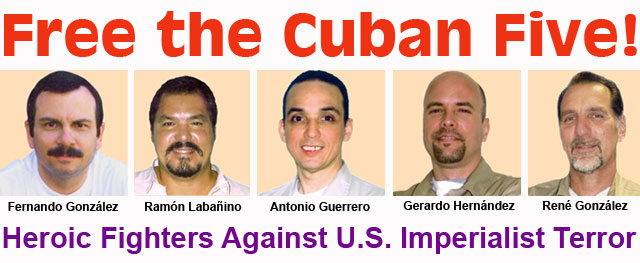
On Friday 7 October, Rene Gonzalez, one of the Cuban Five incarcerated in United States since 1998 for combating terrorism against Cuba, faces a ‘supervised release’ under life-threatening conditions. In 2001, Rene was sentenced to 15 years in prison charged with conspiracy to act as a non-registered foreign agent. He had already spent 33 months in ‘preventative custody’, including 17 months in isolation in ‘the hole’.


Rene’s real crime, like that of his co-defendants (Gerardo Hernandez, Antonio Guerro, Ramon Labanino, Fernando Gonzalez), was defending Cuba against acts of terrorism planned, financed and launched by Cuban exile groups in Miami; groups with well documented links to the US government agencies. The conditions imposed by Federal Court Judge Lenard on Friday 26 September 2011, force Rene to reside in Miami for three years, without returning to Cuba to be with his wife (who has been permitted to visit him just once by US authorities) and two children.

Rene was born in the United States in 1956, but returned to Cuba as a child just after the Cuban Revolution in 1961. He became a pilot and flight instructor. Between 1977 and 1979 he was among thousands of Cuban combatants who fought for the national liberation of Angola and against the racist apartheid regime of South Africa. In 1990, at the request of the Cuban government, Rene returned to the United States to gather information in order to prevent terrorist plots against Cuba.

The Cuban Five had no guns and no explosives. They were not after classified information or threatening US national security. They were gathering information and evidence from terrorist networks about actions planned and launched from US soil. In the 1990s more than 200 attacks were launched from Miami, many of them targeting Cuba’s expanding tourist industry. In 1998, Cuba handed the FBI a mountain of evidence compiled by the Cuban agents from the terrorist networks in Miami. That information made it possible to successfully prevent 170 attacks against Cuba, including a plan to blow up aeroplanes filled with Cuba-bound tourists from Europe and Canada. Instead of acting on the information to break the terror networks, the FBI arrested the Cuban agents.

The utter hypocrisy of the US judiciary is emphasised by the conditions established for Rene’s ‘supervised release’, which prohibit him ‘from associating with or visiting specific places where individuals or groups such as terrorists, members of organizations advocating violence, organized crime figures are known to be or frequent.’ In other words, the court can identify where terrorists and criminals hang out in Miami, but rather than arrest and put them on trial, it warns Rene, a US-citizen who has actively opposed terrorism, not to disturb them. So much for the war on terrorism!

Perversely, while warning Rene to stay away from these groups and individuals, the court will not permit him to do the only thing which would secure his safety – return to Cuba. The conditions force him to remain in the same city as the terrorists he was monitoring, where the ‘show trial’ took place, during which journalists were paid by the US government to secure a conviction, and which has a powerful right-wing Cuban exile population. Among Miami’s Cuban exile residents is Luis Posada Carriles, an ex-CIA agent, responsible for bombing a Cuban civilian aeroplane in 1976, killing all 73 persons aboard, and the bombing of hotels and restaurants in Havana in 1997. Carriles recently reaffirmed his support for further violence against Cuba.

‘Why is the Court putting Mr Gonzalez’s safety at risk by forcing him to live for the next three years side by side with the very terrorists that he tailed as an unregistered Cuban agent?’ demands José Pertierra, an attorney representing the Venezuelan government’s extradition case against Carriles.

Terrorism against Cuba has cost the lives of 3,478 Cubans and permanently maimed another 2,099. Rene’s life is at risk if he is forced to remain in Miami. Judge Lenard, who issued the ‘supervised release’ has justified her decision by stating that if Rene returns to Cuba she won’t be able to assess whether the US public ‘will be protected from further crimes of the defendant’. But as Pertierra responds: ‘His only “crime” was failing to register as a foreign agent.’ Absurdly, Judge Lenard also claims more time is needed to ‘provide the defendant with needed educational or vocational training, medical care, or other correctional treatment in the most effective manner’. This is nonsense. Rene has declared his intention to renounce his US citizenship and return to live in Cuba with his family, he does not need to be ‘reintegrated’ into US society. Pertierra adds: ‘As for medical care, he will have access to the best medical care in Cuba and it will be available at no expense to the United States or to himself.’

Judge Lenard’s decision allows Rene to re-file his motion to return to Cuba at a later time ‘should circumstances warrant modification’. Pertierra asks: ‘What circumstances could she be waiting for? For a terrorist to take a potshot at Rene?’

However, for right-wing Cuban-exile community even this ‘supervised release’ is too generous. Miami Republican Congresswoman Ileana Ros-Lehtinen, Chairman of the US Senate’s Foreign Affairs Committee, condemned Rene’s release stating on 3 October that: ‘He has American blood on his hands and dedicated his life to harming our country on behalf of a regime that is a state sponsor of terrorism.’ This from a woman who just weeks ago called for Cuba to be attacked Libya-style; an attack which has so far cost the lives of 50,000 to 60,000 Libyans.

In early September, RATB activists participated in two anti-terrorism events in Havana. The first, on Saturday 10 September, commemorated the 14th anniversary of the murder of Italian tourist Fabio di Celmo, killed in the 1997 explosion at the Copacubana hotel in Havana. Guistino di Celmo, Fabio’s elderly father thanked the Cuban people for remembering his son and complained that, years after the terrorist act which took his son’s life, the US press continues to report the lie that Cuba supports terrorism, while the Cuban Five remain in US prisons for combating terrorism. Magalys Llort, mother of one of the Five, presented Guistino with a plaque in homage to his son made by Gerardo Gonzalez, another one of the Cuban Five.

Two days later, RATB joined thousands of representatives of Cuba’s grassroots organisations, cultural organisations, military, foreign diplomats, foreign students and Cuban workers in a cultural event to honour the Cuban Five, whose poems and letters were put to music. President of Cuba’s National Assembly, Ricardo Alarcon, condemned the conditions imposed on Rene Gonzalez’s ‘supervised release’ and pointed out that the case of the Cuban Five proves the US government is complicit with terrorist groups in Miami.

Rock around the Blockade joins international condemnation of this cruel and unusual punishment meted out to Rene and the Cuban people who are waiting to welcome him home. We demand the full, immediate and unconditional release of the Cuban Five and the trial of those terrorist plotters and supporters in the United States, including all those in US government agencies.

US SMS campaign targets Cuba

Attacking censorship: U.S. text-messaging campaign targets Cuba
Source: CubaMoneyProject, 01 October 2011.

A Maryland company has won a U.S. government contract to set up a system capable of sending tens of thousands of text messages every month to Cuban cell phone users who want to receive news and information from TV and Radio Martí. Washington Software, Inc., will design a text messaging system aimed at countering Cuban government attempts to block politically sensitive messages, according to a Sept. 23 award notice. The Broadcasting Board of Governors, or BBG, solicited bids for the text-messaging service on Aug. 17. The base contract is worth $84,000 during the first year. Four additional one-year options would boost the total value of the contract to $464,160. One prospective contractor wondered if the text-messaging campaign was legal. He wrote:
We are concerned with the legality of sending these types of notifications to people in another country. Does the US government take all legal responsibility for these messages? Are there legal considerations a vendor would have to be aware of on these kinds of broadcasts?

The BBG replied:
The Agency assumes responsibility for the content of the messages. The Contractor assumes all responsibility under this requirement and should consider all aspects of this requirement before submitting an offer.

Translation: If you’re worried about legal trouble, don’t bother to apply.

The International Broadcasting Bureau, which oversees Miami-based Radio and TV Martí, explained the need to get around Cuban censors.
The IBB’s Internet anti-censorship program seeks to ensure Internet users in target countries are able to access USG broadcasters’ web sites to access their news and other programming, using a variety of tools to counter foreign government-sponsored Internet censorship controls. These techniques must include the ability to add unique changes to each message instance sent to each individual subscriber to avoid detection of messages being sent in bulk to many subscribers. Additionally, these techniques may include keyword substitutions, where potentially provocative keywords which are likely to be censored are replaced with other words or characters which leave the meaning intact but foil automated keyword detection.

FedBizOpps.gov lists Washington Software as the winning contractor. The firm’s first-year contract runs from Sept. 15, 2011, through Sept. 14, 2012. The government contract requires that the contractor be able to distribute up to 24,000 total messages per week – and that amount may rise, depending on events in Cuba. Washington Software has been in business since 1998. Its address is 20410 Century Blvd, Ste 220, Germantown, Maryland. Its clients include the U.S. Department of Education, the Department of Health & Human Services and the Department of Labor and other government agencies. Washington Software also serves such businesses as IBM and Lockheed Martin. The company website states:
We are an IT Solution Provider and we pride ourselves in our experience, knowledge, and skill set to provide our clients with positive results. We utilize a secure and agile methodology alongside proven technologies to maximize our efforts in our projects. Our main focus has been to satisfy our commercial and government organizations located in our region.

The full text of the bid is here

Thursday, 29 September 2011

Cuba’s Report On Resolution 65/6 of the UN General Assembly on ending the US blockade

Cuba Report 2011

Sunday, 25 September 2011

‘Another terrible injustice’: A message from the Cuban Five on the execution of Troy Davis

Source; National Committee to Free the Cuban Five
by the Cuban Five, 23 September 2011.

The message below was sent by Ramón Labañino on behalf of the Cuban Five. The Cuban Five are political prisoners in the United States, serving four life sentences and 75 years collectively after being falsely convicted of politically motivated criminal charges while monitoring the operations of anti-Cuba terrorist organizations in Miami.
Brothers and sisters: We feel deeply the horrific execution of Troy Davis. It is another terrible injustice and stain on the history of this country. We join in the pain felt by his relatives, friends and brothers across the world. Now we have another cause, another flag, to pursue our struggle for a better world for all, free of the death penalty and barbarism. In Troy’s honor, and all the innocents of the world, we must continue, united, until the final victory! Our most heart-felt condolences!
Five fraternal embraces,
Antonio Guerrero
Fernando González
Gerardo Hernández
René González
Ramón Labañino

Cuba launches campaign for Cuban Five

Source: South Journal, 11 September 2011.

The Cuban people, headed by the youth, kick off a nationwide campaign on Monday for the release of the five Cubans held in US jails for 13 years. The Campaign will run until October 6 and it will include actions not only in Cuba but also in other countries of the world, where people will demand the release of Gerardo Hernández, Ramón Labañino, Antonio Guerrero, Fernando González and René González, known as the Cuban Five.


The initiative´s program includes views exchange, arts exhibitions, galas, an anti-imperialist tribunal, book launchings and other activities to start September 12, marking thirteen years of imprisonment of the Five.

Here a chronicle of the case:
September 1998: five Cubans were arrested in Miami by the FBI and held in punishment cells for 17 months before their case was taken to court. These Cubans were in the United States monitoring Florida-based ultra-right organizations of Cuban origin that had undertaken terrorist actions against Cuba, and even in US territory, over the past 50 years.

The five Cubans named Gerardo Hernandez, Ramon Labañino, Fernando Gonzalez, Antonio Guerrero and René Gonzalez were charged with conspiracy against the United States. Three of them, Gerardo, Ramon and Antonio were also accused of conspiracy to commit espionage. But the US government never asserted that such act was committed. They were never proven to have possessed any classified document. Despite energetic objection by the defense, the case was taken to a court in Miami, a community harboring over half a million Cuban exiles with long hostile records against the Cuban government.

Miami was the environment which, a US federal appeal court described later as “the perfect storm” of prejudices that did not favor a fair trial. And this trial took over six months, being considered the longest such process ever in the United States. Three retired US army generals, a retired admiral, the former advisor to Bill Clinton on Cuban issues testified at the trial and said there was no evidence of espionage. Seven months after the official accusation was issued, a new charge was imposed on Gerardo Hernandez: conspiracy to committee assassination. This was the result of a huge media and public campaign to take revenge for the downing in 1996, by the Cuban air force, of two planes belonging to the Florida-based anti-Castro group “Brothers to the Rescue” and the death in the action of four members of this organization. The Brother to the Rescue planes had illegally entered Cuban airspace 25 times prior to the incident and during 20 months, which led to reiterated protests by the Cuban government.

At the end of the trial, just when the case was almost ready for sentencing, the US administration admitted its failure at proving the charge of conspiracy to commit assassination imposed on Hernandez by saying that in the light of the proofs presented, this would constitute an insurmountable obstacle for the United States in relation to this case and would also result in the failure of the specific accusation. However, the jury found Gerardo Hernandez and the other four Cubans guilty of all charges, following intense pressure by the local media.

The Cuban Five, as these men are known around the world, were given 4 life terms and 77 years. This conviction turned three of them into the first people in the United States to have been given life terms in espionage-related cases, in which there was no evidence of their possession or transfer of any secret document. And then, they were confined to five different high-security prisons, far off from each other and with no communication among them whatsoever.

THE NINE-YEAR LONG APPEAL
 August 9, 2005: A three judge panel with the Atlanta Court of Appeals revoked the court ruling after considering that the Cuban Five were not given a fair trial in Miami. But, the US government requested the rehearing by the Court en banc of the decision reached by the three-judge panel. This procedure is an action that only takes place in cases involving constitutional principles. One year later, the court revoked, by majority, the unanimous decision of the three judges.

May 27, 2005: The United Nations Working Group on Arbitrary Detentions, after having considered the arguments presented by the relatives of the Cuban Five and by the US government, described the convictions as arbitrary and called on Washington to take the necessary measures to correct such decision.

September 2, 2008: Atlanta´s Court of Appeals ratified the guilty verdicts, upheld the convictions against Gerardo Hernandez (two life terms plus 15 years) and against Rene Gonzalez (15 years) while it annulled the sentences against Antonio Guerrero (life term plus 10 years), Fernando Gonzalez (19 years) and Ramon Labañino (life term plus 18 years) for considering them incorrect. So the cases of the three men were sent back to the Miami Court to be resentenced. The Court admitted the absence of any piece of evidence about the possession or transmission of any secret information or related to US national security in the case of the defendants under the charge of conspiracy to committee espionage. Some months later Antonio Guerrero was resentenced to 21 years and 10 months in prison, plus a 5-year parole; Fernando was given 17 years and 9 months in prison; and Ramon 30 years in jail.

June 15, 2009: The US Supreme Court announced, without further details, its decision not to review the case of the five men despite the unquestionable arguments submitted by the defense in the face of evident and countless legal violations committed during the whole process. With this decision, the US justice also turned a deaf ear on the huge world support of this petition and of the Cuban Five, which was openly expressed in 12 amicus curiae documents—an unprecedented action since it has been the largest number of such documents ever filed with the US Supreme Court requesting the revision of a criminal case. The amicus curiae documents were signed by ten Nobel laureates including the president of East Timor, Jose Ramos Horta; Adolfo Perez Esquivel, Rigoberta Menchu, Jose Saramago, Wole Soyinka, Zhores Alferov, Nadine Gordimer, Gunter Grass, Dario Fo and Maired Maguire; the Mexican Senate; Panama´s Parliament; former Irish President, Mary Robinson who was High UN Commissioner for Human Rights (1997-2002), and the former director of UNESCO, Federico Mayor, among others. From the legal point of view the case has concluded. The Cuban Five are now undertaking an extraordinary process, which is known as Habeas Corpus. This is a one-time opportunity of the defendants after all appeal resources have concluded with no success.

In October 2010, Amnesty International issued a report on the case, which read that if the legal appeal process did not yield on-time compensation, and given the long sentences imposed and the term already served by the Five, the organization would support all calls on US authorities to review the case through the proceeding of pardon or any other appropriate ways.


Cuban Five Demand Freedom 
by Teresita Jorge Carpio

The Cuban Five have been victims of an unfair conspiracy after being detained on September 12th 1998 for having infiltrated terrorist organizations based in southern Florida aimed at stopping actions against the Cuban people. Gerardo Hernández, René González, Ramón Labañino, Fernando González and Antonio Guerrero were abruptly striped from their family and submitted to a biased trial in Miami and later sentenced to long unfair prison terms ranging from 15 years to 2 life plus 15 years.

Their defense statements were impressive, sincere and passionate. Tony Guerrero´s defense was poetic stating that they will always defend their principles and cause in their unjust imprisonment. His final words affirm a better future when he said: Because, at the end, we shall rest free and victorious beneath that sun which we are denied today. Rene did not request clemency, but justice for his comrades accused of crimes they did not commit, while Ramon proclaimed: I will wear the prison uniform with the same honor and pride with which a soldier wear his most prized insignias! Fernando concluded by saying: In my years in prison, I always carry with me the dignity I have learned from my people and their history. Gerardo Hernandez was also an example of integrity and dignity when he praised US patriot Nathan Hale saying: My only regret is that I have but one life to give for my country." Love and hope irradiate the letters of these five men that synthesizes a history of value, sacrifice and love as characterized by African American writer Alice Walker.

A phrase by French writer Victor Hugo became their own: "Love, you know, seeks to make happy rather than to be happy." Sweetness and kindness accompany the heroism of the Cuban Five in its incarceration in the dark dungeon, witness of their commitment to the Homeland and their loved ones. To his jewels, as characterized Ramon Labañino to his wife Elizabeth Palmeiro and daughters, he said: Love is the most profound feeling in our lives. Rene Gonzalez, one of the five anti terrorist fighters incarcerated for the last 13 years write to his daughter Ivette: Your good qualities today will turn into virtues tomorrow. In every letter, message or telephone contact, Gerardo, Rene, Ramon Fernando and Tony constantly transmit a message of love and hope.

These five men, characterized by Gail Walker as heroes are dignified heirs of Jose Marti. Homeland is Humanity, said Cuba´s National Hero. They are an international symbol from their prison cells in the fight for peace and for making a reality the desire that a better world is possible. Their loyalty for the Homeland and firmness of the principles are an example for the honest citizens of the world that demand the immediate release of the five giants, as characterized by the leader of the Cuban Revolution Fidel Castro.

Cuba excluded from UN 2010 Human Development Index

Source: CaricomNews Network, 19 February 2011.

by Calvin G. Brown

Cuba is protesting its exclusion from the United Nations 2010 Human Development Index (HDI) calling it a political manipulation aimed at trying to ignore the great strides that country’s development.A statement on the matter from the Cuban Embassy noted that “In the 2009 Human Development Report, Cuba was listed as the 51 country worldwide, preceded only by developed countries and by Argentina, Chile and Uruguay, which means that we were part of the list of “High Human Development” countries. In 2010, if you analyze health and education only, Cuba would rank 17 and considering the Gross Domestic Product it would move into place 36 in the HDI, which would place us on the list of countries with a “Very High Human Development”, where developed nations are ranked.”

Human Development Index (HDI) which is published by the United Nations, is a world reference for the assessment of a country’s human development level and is used to make comparisons at a global level. “Whichever way you look at it, this is a political manipulation aimed at ignoring Cuba’s headways. The 2010 HDI bases its indicators on inequalities and poverty, in which Cuba would rank at an outstanding position worldwide for being one of the countries where citizens have universal and free access to health, education up to university and postgraduate levels, employment and social security regardless of race or gender, which is acknowledged throughout the world in UNDP precedent reports and in the reports issued by other international organizations like UNESCO and the WHO, among others,” the Cuban statement declared.

According to the statement, “the reason put forward by the Office that drafts this report is that Cuba is among the 4 countries of the world which have the data of all the HDI components except for the gross domestic product (GDP), since it does not use the “global purchasing power parity” (PPP) method used by the World Bank and therefore by the HDI to determine its GDP.” Cuba says “this justification is a falsehood, as Cuba worked with CEPAL in 2005 to resolve those difficulties in relation to the Cuban indicators and our data have been officially acknowledged by the UN system. In fact, our Gross Domestic Income was posted on the UNDP Website until the day following the publication of the HDI Report, time at which it was suppressed.”

The report violates the provisions contained in resolution 57/264 of the United Nations General Assembly, which establishes the process for its drafting, particularly, for the drafting of the Human Development Report that should be drawn up in a neutral and transparent way, in full and effective consultation with Member States and bearing in mind the unbiased character and the use of the sources.

Among the most negative elements identified in relation with our country is the inclusion of indicators not approved by the inter-governmental organs. The attempts of the UNDP and the HDI Office to draw up assessments and data on issues that are above their competence have been the object of the widest rejection by member states and given rise to resolutions of the UN General Assembly. This is not the first time that Cuba is excluded from the HDI. In 2001, Cuba was not included “by chance” due to the lack of data on the gross domestic product. That incident provoked the reaction that led to the promotion and adoption of resolution 57/264.

The information on Cuba in the 2010 HDI Report is not only unacceptably tendentious but it also twists the reality of a country that has endured the longest and most unjust economic, commercial and financial blockade in the history of mankind; a policy that represents the main hindrance to its development. Despite of that, Cuba shows significant results on social matters, which are internationally acknowledged.

This kind of manipulation of statistical data with political ends against Cuba, which lacks objective bases, far from favoring prestige and the acknowledgement merited by an organ like the UN Development Program, arouses discredit, categorical rejection and lack of trust from Cuba. The UNDP must refrain from favoring these ignominies against UN member states. Cuba demands a public, oral and written rectification in relation with the information on the Human Development Index so that our results are known.

Monday, 12 September 2011

RATB reports: solidarity with the Cuban 5 – September 2011

Rock around the Blockade – events in Britain in solidarity with the Cuban 5 – September 2011

On Saturday 10 September, as part of the international days of action for the Cuban 5, on the 13th anniversary of their incarceration in US gaols, members and supporters of Rock around the Blockade in Britain, supported by the Revolutionary Communist Group, held street rallies in four cities: in Glasgow by Donald Dewar Statue, in Newcastle at Grey’s Monument, in Manchester’s Piccadilly Gardens and in Trafalgar Square in London.

We gathered under banners demanding the freedom for the five political prisoners, Gerardo Hernández, Ramón Labañino, Fernando González, Antonio Guerrero and René González, and with petitions, leaflets, flags and placards, with open microphones, speeches and music, we ensured that everyone who passed the stalls understood the significance of the day and the importance of the Cuban 5, the need to build the campaign for their freedom and solidarity with the socialist revolution in Cuba. The Cuban 5 may have exhausted their legal avenues in the US, but the political struggle on the streets all around the world goes on.


Comrades gave speeches in solidarity with the Cuban Revolution and against the US blockade, they talked of the gains made in Cuba, contrasting this with the cuts in public services in Britain in the current economic crisis where health care and education for all are under threat. Speakers raised the issue of the vengeance of the capitalist state against those who pose any threat, as we are witnessing currently in the aftermath of the uprisings in August in cities in Britain. The US and Britain continue shamelessly to use the guise of fighting terrorism while bombing, killing, torturing and incarcerating those who rise up against imperialism. The movement against this oppression must be anti-imperialist, militant and uncompromising. Socialist Cuba and the Cuban 5 are showing the way.

The international days of action for the Cuban 5 have also been marked by Rock around the Blockade with film showings in all these four cities of Saul Landau’s award winning documentary, Will the real terrorist please stand up, released this year which tells the hidden story of 50 years of US terrorism against Cuba, presenting the case of the Cuban 5.

Rock around the Blockade has the following message for the Cuban 5:

‘Dear comrades,

We are writing to you with solidarity on the 13th anniversary of your detention and imprisonment. We organise regular demonstrations, meetings, film showings and solidarity brigades for Cuba because we know that Cuba is a beacon of hope for oppressed people around the world. We know that here in imperialist Britain we have a lot to learn from socialist Cuba and it is the only way to destroy the state and overthrow capitalism. We want to thank you for your continued struggle in the prisons of the US and we want you to know that we take a lot of inspiration from your fight and the continued advances of the Cuban revolution. We are not going to stop until capitalism is destroyed and you are free.

With much love and solidarity,

Rock around the Blockade’

For more information about Rock around the Blockade visit www.ratb.org.uk

Cuba Solidarity campaign joined in with RATB in Manchester, 10 September 2011.
________________________________________________________________________
Rock around the Blockade – Gran Bretana– solidaridad con los Cinco Cubanos - September 2011

El sábado 10 de septiembre, los miembros de Rock around the Blockade y el Grupo Comunista Revolucionario, realizó un evento animada en las calles de Newcastle upon Tyne, Manchester, Glasgow y Londres, Gran Bretana, exigiendo la libertad de los 5 cubanos. Los compañeros dieron discursos en solidaridad con Cuba Socialista, contra el bloqueo de EE.UU. y en contra de la prisión ilegal de los cinco héroes cubanos. Los habitantes se detuvo a firmar peticiones para los 5 cubanos y firmar cartas de solidaridad que han sido enviados a Gerardo Hernández, Ramón Labañino, Fernando González, Antonio Guerrero y René González. La manifestación marcó 13 años desde su detención en Miami y busca destacar el caso de los 5 cubanos y fomentar la solidaridad con la Revolución Socialista Cubana. Rock around the Blockade tiene el siguiente mensaje para los 5 cubanos y sus partidarios


‘Queridos compañeros,

Nos dirigimos a ustedes con la solidaridad en el 13 aniversario de sus detención y encarcelamiento. Se organizan manifestaciones periódicas, reuniones, proyecciones de películas y brigadas de solidaridad de Cuba, porque sabemos que Cuba es un faro de esperanza para los pueblos oprimidos de todo el mundo. Sabemos que aquí en Gran Bretaña imperialista que tenemos mucho que aprender de Cuba socialista y es la única manera de destruir el Estado y derrocar el capitalismo. Queremos darle las gracias por su continu luacha en las cárceles de los EE.UU. y queremos que sepan que tenemos un montón de inspiración de que la lucha continúa y los avances de la revolución cubana. No vamos a dejar de luchar hasta que el capitalismo se destruye y ustedes son libres.

Mucho amor y solidaridad.

Rock around the Blockade’


El fin de semana de acción culmina en una película que muestra de "¿El verdadero terrorista por favor ponerse de pie", un premiado documental lanzado este año cuenta la historia oculta de 50 años de terrorismo estadounidense contra Cuba, al presentar el caso de la Cinco cubanos. Los entrevistados son renombrados terroristas Luis Posada Carriles, Orlando Bosch, José Basulto y otros, que tengan libertad de caminar por la calles de Miami, apoyado y protegido por el gobierno de EE.UU., junto con
imágenes raras de la invasión de Bahía de Cochinos.


Para más información sobre Rock around the Blockade, visita www.ratb.org.uk

Tuesday, 6 September 2011

Cuba refuses to recognize the Transitional National Council in Libya

by the Cuban Foreign Ministry

Translation by Yoshie Furuhashi

The Foreign Ministry of Cuba has withdrawn its diplomatic staff from Libya, where foreign intervention and NATO military aggression has exacerbated the conflict and prevented the Libyan people from advancing toward a peaceful negotiated solution, in full exercise of their self-determination.

The Republic of Cuba does not recognize the Transitional National Council, nor any provisional authority, and will only recognize a government established in Libya in a legitimate manner, without foreign intervention, through the free, sovereign, and common will of the brother people of Libya.

Ambassador Víctor Ramírez Peña and First Secretary Armando Pérez Suárez, accredited in Tripoli, have maintained impeccable conduct, strictly observing their diplomatic status, have endured risks, and have stood by the Libyan people in this tragic situation. They have directly witnessed the NATO bombings of civilian targets and deaths of innocent people.

Under the grotesque pretense of protecting civilians, the NATO has murdered thousands of them, disregarded the constructive initiatives of the African Union and other countries, and even violated the questionable resolutions imposed at the Security Council, in particular by its attacks on civilian targets, by its financing and arming of one side, and by its deployment of diplomatic and operational personnel on the ground.

The United Nations has ignored the clamor of international public opinion in defense of peace and ended up becoming complicit in a war of conquest. The facts confirm the early warnings of Commander in Chief Fidel Castro Ruz and the timely condemnations issued by Cuba at the UN. Now the world can see better what purpose the so-called "Responsibility to Protect" serves in the hands of the powerful.

Cuba declares that nothing can justify the murder of innocent people.

The Foreign Ministry demands the immediate end to NATO bombings, which continue to claim lives, and reiterates the urgent need to permit the Libyan people to find a peaceful negotiated solution, without foreign intervention, in exercise of their inalienable right to independence and self-determination, to sovereignty over their national resources, and to the territorial integrity of that brother nation.

Cuba condemns the conduct of the NATO, which is aimed at creating similar conditions for intervention in Syria, and demands the end to foreign intervention in that Arab country. Cuba calls upon the international community to prevent a new war, urges the United Nations to abide by its duty to safeguard peace, and supports the right of the Syrian people to full sovereignty and self-determination.

Havana, 3 September 2011

--------------------------------------------------------------------------------
The original statement "Declaración del MINREX: Cuba no reconoce al Consejo Nacional de Transición" may be read at CubaDebate.cu


See also: Nicaragua refuses to recognise NTC, calls NATO drunken warmonger, 05 September 2011.

Saturday, 27 August 2011

Weekend of action for the Cuban 5!

Over the weekend of 10-11 September 2011, RATB activists across Britain will be organising activities in support of the Cuban 5 as they approach the 13th anniversary of their 'kidnapping' and imprisonment by the US government.

In Manchester on Saturday 10 Sepember, we will be holding a campaign stall with leaflets, petitions and a speak-out in Piccadilly Gardens, city centre starting at 12 noon. The following day we will be showing the new film by Saul Landau, 'Will the Real Terrorist Please Stand Up' in the Cross Street Chapel, Cross Street, starting at 2pm. Make sure you put the film show in your diary, this will be the first time the film has been showed anywhere in the North West.


Free the Cuban 5!
Solidarity With Socialist Cuba!


RATB events you can join in

FREE FILM SHOWINGS

Will the Real Terrorist Please Stand Up (2011, Saul Landau), telling the story of the Cuban Five and a half century of hostile US-Cuban relations.

LONDON
Sunday 4 September, 5pm
The Compass pub, corner of Chapel Market and Penton Street
Angel, Islington, N1

MANCHESTER
Sunday 11 September, 2pm
Cross Street Chapel
Cross Street, M2

NEWCASTLE
Tuesday 13 September, 7pm
Barkollo
22 Leazes Park Road, NE1

GLASGOW
Wednesday 14 September, 7.30pm
Langside Halls,
Shawlands, G4


RALLIES AND PROTESTS FOR THE CUBAN FIVE

LONDON
Saturday 10 September, 12-3pm
In front of the National Gallery. Bring stalls, literature, banners and music.
Trafalgar Square, Central London

MANCHESTER
Saturday 10 September, 12-3pm
Piccadilly Gardens

NEWCASTLE
Saturday 10 September, 12-3pm
Grey’s Monument
Grey Street, NE1

GLASGOW
Sunday 11 September, 1-3pm
Donald Dewar Statue
Buchanan Street, G1

Free the Cuban Five! - Defend the socialist revolution in Cuba

Source: Fight Racism! Fight Imperialism! (FRFI) no. 222, August/September 2011.

by Ali Erkaslan

12 September 2011 will mark 13 years since the arrest in Miami, Florida of five Cuban intelligence agents who had infiltrated right-wing terrorist organisations in the United States to help foil terrorist attacks against the Cuban people. They remain incarcerated in US prisons. The campaign for their release is an essential part of the struggle to defend Cuban socialism. In September, Rock around the Blockade will join activists from around the world demanding the release of the Cuban Five.

Government-funded propaganda operation in Miami exposed - Part 1

Source: Reporters for Hire

by Gloria La Riva

More than 2,200 pages of documents obtained through FOIA

In 1998, five Cuban men were arrested by the U.S. government and tried in Miami on charges of conspiring to commit espionage on the United States.

The five men’s mission was to stop terrorism, keeping watch on Miami’s ultra-right extremists to prevent their violent attacks against Cuba. “The Cuban Five,” as they are now known, were convicted after repeated denials by the judge to move the trial venue out of Miami. The U.S. government insisted that they be tried in Miami.

What the Cuban Five and their attorneys did not know during trial was that the U.S. government—through its official propaganda agency, the Broadcasting Board of Governors—was covertly paying prominent Miami journalists who, at the same time as the government conducted its prosecution, saturated the Miami media with reports that were highly inflammatory and prejudicial to the Cuban Five.

The presence of Miami journalists on the U.S. government payroll, who purported to report as “independent” press, goes to the heart of the unjust conviction of the Five. The Five were not only victims of a politically-motivated prosecution, but a government-funded propaganda operation as well.

Lawrence Wilkerson, chief of staff for Colin Powell when he was Secretary State from 2001 to 2005, commented about the inability of the Cuban Five to receive a fair trial in Miami:

When the case came to trial, a change of venue was warranted and asked for because no Miami court was going to give the Cuban Five a fair trial, since the city is largely in the hands of some of the very Cuban-Americans and their supporters who've allegedly perpetrated these atrocities on the Cuban people and are prepared to invade the island. But the change of venue motion was denied. And of course the five were convicted.

Wilkerson has called for the release of the Cuban Five.

So, too, has former U.S. president Jimmy Carter, who stated:

I believe that there is no reason to keep the Cuban Five imprisoned, there were doubts in the U.S. courts and also among human rights organizations in the world. Now, they have been in prison 12 years and I hope that in the near future they will be released to return home.

CIA forced to release long secret official history of Bay of Pigs invasion

National Security Archive Lawsuit Yields Never-Before-Seen Volumes of Massive Study; Agency Continues to Withhold Volume 5
by Peter Kornbluh, Global Research, 02 August 2011.

Pursuant to a FOIA lawsuit filed by the National Security Archive on the 50th anniversary of the infamous CIA-led invasion of Cuba, the CIA has released four volumes of its Official History of the Bay of Pigs Operation. The Archive today posted volume 2, "Participation in the Conduct of Foreign Policy" (Part 1 | Part 2), classified top secret, which contains detailed information on the CIA's negotiations with Guatemala, Nicaragua, and Panama on support for the invasion.

"These are among the last remaining secret records of this act of U.S. aggression against Cuba," noted Peter Kornbluh, who directs the Cuba Documentation Project at the Archive. "The CIA has finally seen the wisdom of letting the public scrutinize this major debacle in the covert history of U.S. foreign policy." Kornbluh noted that the agency was "still refusing to release volume 5 of its official history." Volume 5 is a rebuttal to the stinging CIA's Inspector General's report, done in the immediate aftermath of the paramilitary assault, which held CIA officials accountable for a wide variety of mistakes, miscalculations and deceptions that characterized the failed invasion. The National Security Archive obtained the declassification of the ultra-secret Inspector General's report in 1998.

Volume 2 provides new details on the negotiations and tensions with other countries which the CIA needed to provide logistical and infrastructure support for the invasion preparations. The volume describes Kennedy Administration efforts to sustain the cooperation of Guatemala, where the main CIA-led exile brigade force was trained, as well as the deals made with Anastacio Somoza to gain Nicaragua's support for the invasion. CIA operatives, according to the study, took over diplomatic relations with Anastacio Somoza, pressuring the State Department to agree to loans to Nicaragua as a quid pro quo for covert support of the invasion.

Volume 3 of the Official History was previously declassified under the Kennedy Assassination Record Act; and volume 4 was previously declassified to the CIA historian, Jack Pheiffer, who wrote the study in the late 1970s and early1980s. The Archive will post a detailed assessment of the declassified history, along with two other volumes tomorrow.

Read more...


vol 1:
http://www.gwu.edu/~nsarchiv/NSAEBB/NSAEBB355/bop-vol1-part1.pdf
http://www.gwu.edu/~nsarchiv/NSAEBB/NSAEBB355/bop-vol1-part2.pdf
http://www.gwu.edu/~nsarchiv/NSAEBB/NSAEBB355/bop-vol1-part3.pdf

vol 2:
http://www.gwu.edu/~nsarchiv/NSAEBB/NSAEBB355/bop-vol2-part1.pdf
http://www.gwu.edu/~nsarchiv/NSAEBB/NSAEBB355/bop-vol2-part2.pdf

vol 3:

http://www.gwu.edu/~nsarchiv/NSAEBB/NSAEBB355/bop-vol3.pdf


vol 4:
http://www.gwu.edu/~nsarchiv/NSAEBB/NSAEBB355/bop-vol4.pdf

Will the Real Terrorist Please Stand Up Indeed!

Source: The Havana Note
by Lawrence Wilkerson, 11 April 2011.

Several nights ago (6 April), I watched “Will the Real Terrorist Please Stand Up” at the West End Cinema in Washington. Six months ago, Saul Landau, the filmmaker, had given me an earlier rough-cut version on DVD that I had watched, but I was not prepared for the final version with all of the added footage gained by Saul’s recent sojourn in Cuba itself and the slap-in-the-face showing on the large screen.

But the added footage from the island and the bigger screen were not all that made the final version more electrifying. It was, all in all, the pro-Cuba aspect of the film that stunned me.

And it was clear that this pro-Cuba aspect was not conjured by the filmmaker but by history. Perhaps, I told myself, I knew much of this history, intellectually, academically. But I had never seen it so graphically put before me, in such a tight, cinematic package that seemed to leap off the screen almost in synch with the beating of my pulse.

The backdrop of the film was the U.S.-Cuba relationship from the 1959 revolution to the present. That relationship was portrayed quite accurately, leaving no doubt why Theodore Roosevelt referred to the island as “that infernal little Cuban Republic” even though TR pre-dated the revolution by a generation-plus. That is chiefly because the one-sided nature of U.S. policy has been the same from 1823 to the present. TR’s remark demonstrated well before the Cuban revolution, well before the dictator Fulgencio Batista, well before the U.S. mob took over Havana, well before Fidel Castro shouted “¡Bastante!” from the Sierra Maestra, well before Jesse Helms displayed his latent racism toward Cubans, just how badly the U.S. had treated its island neighbor since the beginning of our republic. So badly, in fact, that the portrayal of it, however evanescently, by a master filmmaker made one want to weep for his country and its policies. I doubt there was a single person in the audience that night who felt any differently, except perhaps the several Cubans who were present who, indeed, probably wept for el coloso del norte as well but for different reasons.

And then there was the main point, the point embodied in the film’s title.

Clearly shown and vividly documented was the fact that the United States sponsors terrorism. In Posada Carriles and Orlando Bosch alone, there are overtones of Osama bin Laden and Aman al-Zawahiri, the nefarious leadership of al-Qa’ida. In the film, Carriles and Bosch as much as tell us this in their own words. Moreover, they seem to rejoice in it, as they live today undisturbed and unmolested in Miami; indeed, as heroes among the ignorant Batista-like refuse whose mother’s milk sustains them. Neither man has even the redeeming feature of religious asceticism that some would argue gives bin Laden and Zawahiri a grudging respect; instead these two terrorists seem precisely what the film depicts, criminal thugs.

Whether it is bringing down a Cuban airliner with more than 70 people on board—including the young people on the Cuban fencing team—or murdering a young Italian man in a Havana hotel, these terrorists appear to take joy in what they have done, declaring in so many words and facial expressions that such deaths are the collateral damage of war. War? Yes, a war waged from the territory of the United States—the state of Florida primarily—and against another sovereign country. A war that continues to this day with the United States doing almost nothing to stop it and, as the film depicts in subtle ways, from time to time even aiding and abetting the terrorists who are waging it.

Once, of course, the dictates and fears of the Cold War afforded a patina of credibility to this war waged from our own shores and against the laws of our own land. As a U.S. soldier for 31 years, I participated in that twilight struggle most of my professional life, so I understood its demands however imperfectly they were sometimes met. But the Cold War ended almost 20 years ago. Not the case, however, with the undeclared war against Cuba.

Perhaps the best cinematic summary of this reality was rendered in the film by none other than the current chairman of the U.S. House of Representative’s Committee on Foreign Affairs, Ileana Ros-Lehtinen, who declared for all to see and hear that she would welcome the assassination of Fidel Castro. No matter how cynical one may have become, that is an astonishing scene. A U.S. Congresswoman asking for the murder of another country’s leader—a most egregious, unbelievable demonstration of this undeclared war with Cuba.

Most vividly and disconcertingly, however, the film goes on to portray this continuing illegal war through the case of the Cuban Five. These are the five Cuban intelligence agents who, in the 1990s, were dispatched to Florida to help the government in Havana defend itself better in this undeclared war.

We know a little of their story. After infiltrating the Cuban-American terrorists ranks in Florida, they accumulated information about planned terrorist activities against Cuba. Alarmed at what they learned, they informed their government in Havana. That government, itself now alarmed, confided in the FBI, hoping that that law enforcement organization would act on the evidence thus accumulated and break up the terrorists ranks in Florida. Instead, the FBI—no doubt at the prompting of the White House—used the information to identify the five Cuban agents, then arrested them. Afterward they were tried in a Miami Court—like trying an Israeli spy apprehended in Iran in a Tehran court. Surprise, surprise, the Cuban Five were not only convicted, twelve years later they are still rotting in U.S. federal prison with the “worst” of them having been awarded two life sentences-plus.

At the very worst, these five Cubans were “foreign agents operating on U.S. soil”, an offense warranting 18 months in jail under U.S. law. As the film makes quite clear, however, usual U.S. practice—for Russians like Anna Chapman, e.g.—is deportation. Instead, these men still languish in jail. Perhaps had they been sexy, provocative women...?

When the film ended and the short, crisp vignettes came on, interspersed among the film’s credits, the main points were hammered home adroitly by some of the film’s principal characters.

As these characters summed up from the screen, I don’t believe there was any doubt in anyone’s mind in that audience—Cuban or American—who the “real terrorist” in the U.S.-Cuba relationship actually is.

The question that had to be buzzing around in everyone’s mind, however, as they walked out of the theater—again, Cuban and American—was what to do about it?

Just like the failure to close the U.S. prison at Guantánamo Bay, the extension of the draconian provisions of “the national security cover-up” methodology in courtroom after courtroom across America, the civil liberties-usurping parts of the Patriot Act, the military tribunals for the likes of Khaled sheik-Mohammad, and on and on in the litany of dangerous and illegal acts by the U.S. Government in the name of perfect security and corrupt, special interest politics, the affair of the Cuban Five, and all it represents about the U.S.-Cuba relationship, stains the very fabric of our democratic republic.

Recently, a long-serving veteran of the CIA wrote a heavily-redacted yet still extremely eloquent and convincing memoir of his days in that agency, days that included the most intense period of our so-called Global War on Terror during the George W. Bush administrations. Here is one of his final conclusions in that memoir:

“I saw that a few of our leaders, in their insularity and sanctimonious certainty, corrupted the laws and started to corrode our social compact. We can take actions, however, to diminish such men, and that reaffirm our society’s commitment to our principles, our institutions, and the rule of law.”

That is the answer to our question and Saul Landau has taken a powerful action.

Colonel, US Army (Retired) Lawrence Wilkerson is the Visiting Pamela C. Harriman Professor of Government at the College of William Mary, as well as Professorial Lecturer in the Honors Program at the George Washington University. His last positions in government were as Secretary of State Colin Powell's Chief of Staff (2002-05), Associate Director of the State Department's Policy Planning staff under the directorship of Ambassador Richard N. Haass, and member of that staff responsible for East Asia and the Pacific, political-military and legislative affairs (2001-02). Before serving at the State Department, Wilkerson served 31 years in the U.S. Army, including as Deputy Executive Officer to then-General Colin Powell when he commanded the U.S. Army Forces Command (1989), Special Assistant to General Powell when he was Chairman of the Joint Chiefs of Staff (1989-93), and as Director and Deputy Director of the U.S. Marine Corps War College at Quantico, Virginia (1993-97). Wilkerson retired from active service in 1997 and then worked as an advisor to General Powell.

Thursday, 25 August 2011

Cuba adopts new economic guidelines to raise production

Source: PSLWeb.org
by Gloria La Riva, 15 August 2011.

Millions participated in meetings to debate policy changes

Cuba’s parliament—the National Assembly of People’s Power—concluded its session in Havana on Aug. 2. The economy was the centerpiece of deliberations. Delegates approved an extensive series of economic and accompanying political measures that have been discussed throughout Cuba since November 2010.

In November, the “Project of Guidelines on the Economic and Social Policy of the Party and Revolution” was published for national debate before its formal presentation at the Sixth Congress of Cuba’s Communist Party (PCC) in April 2011. The consultative process has continued since then.

The objectives of the sweeping proposals are to stimulate the economy and raise production. Some measures are already under way: distributing unused lands for cultivation; decentralizing some state services (beauty parlors, barbershops, tire repair, taxis, and more); reassigning thousands of state workers to jobs in construction, teaching and agriculture and reducing the state work force by tens of thousands more. Opportunities for self-employment and small-scale enterprise have been expanded. Payroll and income taxes will be paid by those engaged in this activity.

Debating the changes were 8,913,838 Cubans—out of a population of 11.5 million—who participated in work and neighborhood meetings to discuss the Guidelines. More than 3 million Cubans commented during the meetings.

Of the original 291 guidelines in the document, 181 were modified and 36 new ones accepted, making a total of 313 guidelines.

Cuban President Raúl Castro said at the National Assembly session, “[W]e can characterize with total certainty the Guidelines as an expression of the will of the people, contained in the policy of the Party, the Government and the State, to update the Social and Economic Model, with the objective of guaranteeing the irreversibility of socialism, as well as the economic development of the country, together with the necessary formation of ethical and political values of our citizens.”

Wednesday, 24 August 2011

US gives asylum to dozens of terrorists and fugitives

by Jean-Guy Allard
Source: Granma, 23 August 2011.

The United States, promoter of the "list of state sponsors of terrorism," whose real purpose is to denigrate nations that reject their policies of domination, has granted asylum to dozens of terrorists, fugitives and swindlers of all types sought by various governments in Latin America.


The website Contrainjerencia.com has established, since the beginning of the year, a list of the better known fugitives. Sixty offenders are identified as Latin American fugitives living in U.S. t, most of them with terrorist pasts.


With the Cuban community in Miami, the "File" had to be limited to the most "infamous" terrorists and killers. The overthrow of Fulgencio Batista, supported by Washington, marked the arrival in South Florida of thousands of accomplices of the dictatorship who the CIA then recruited for terrorist operations which were executed and covered up against the Cuban Revolution.


Several authors of terrorist acts that occurred in Venezuela in recent years have also found asylum in the U.S., as well as participants in the murderous conspiracy of Santa Cruz, Bolivia.


Among others who promoted the use of terror in different countries of the continent and now reside in the United States with the knowledge and approval of the State Department contrainjerencia.com identifies the following characters:


- Alejandro Melgar, leader of the Santa Cruz conspiracy, Bolivian businessman.


- Angel de Fana Serrano, participated in 1997, in the Isla Margarita, in a plot to assassinate Cuban leader Fidel Castro during the Ibero-American Summit. An associate of Luis Posada Carriles, De Fana also conspired to assassinate President Chavez.


- Armando Valladares, an accomplice in the assassination attempt of Santa Cruz, Bolivia, and several terrorist acts, was imprisoned in Cuba for planting bombs in shops and resumed his work with the CIA since his departure from the island.


- Carlos Alberto Montaner, lived for several decades on his performances against Cuba. A fugitive from Cuban justice for planting bombs in shops and cinemas in 1960. He was a member of the terrorist network of Orlando Bosch. He owns homes in the U.S. and Spain.

- Gaspar Jiménez, murderer of Cuban diplomat Dartagnan Díaz Díaz, an accomplice of Luis Posada Carriles and sentenced in Panama for terrorism. Based in Miami with FBI protection.


- Guillermo Novo Sampol, a terrorist, an accomplice in the assassination of former Chilean Foreign Minister Orlando Letelier, a torturer under Operation Condor, the murderer of two Cuban diplomats in Argentina, an accomplice of Luis Posada Carriles for terrorism and sentenced in Panama. Based in Miami.


- Huber Matos, known for directing terrorist activities. His ties to the Central American drug trafficking world are so well known like of his son, who fled to Costa Rica. Based in Miami.


- Hugo Acha Melgar, financier of the terrorist gang made up of Hungarian and Croatian neo-Nazis who tried to assassinate Bolivian President Evo Morales in 2009 in the Santa Cruz plot.


- Joaquim Chaffardet, ex-director of the Venezuelan secret police, linked to international terrorist Luis Posada Carriles. He was trained by U.S. intelligence services School of the Americas (SOA).


- José Antonio Colina Pulido, responsible for bombings of diplomatic offices in Spain, Colombia and in Caracas in 2003. Based in Miami.


- Nelson Mezerhane, financial conman, shareholder in Globovisión, among the main suspects in the murder of prosecutor Danilo Anderson. Disappeared from Caracas stealing seven million dollars.


- Patricia Poleo, an accomplice in the assassination of Venezuelan prosecutor Danilo Anderson. She is located behind a variety of CIA operations conducted with the U.S. embassy in Caracas against the Bolivarian Revolution. Based in Miami.


- Pedro Remon, a CIA assassin, murderer of Felix Garcia Rodriguez and Eulalio Negrin, in New York; accomplice of Luis Posada Carriles, convicted of terrorism in Panama. Based in Miami with FBI protection.


- Luis Posada Carriles, a CIA agent and international terrorist. He has an endless history of crimes. Sought by Venezuela for the 73 murders on a Cuban airliner blown up in 1976. Based in Miami.


- Reinol Rodriguez, associated with Luis Posada Carriles: an accomplice in the murder in Puerto Rico by Carlos Muñiz Varela. Currently military chief of the Alpha 66 terrorist group, tolerated by the FBI. Based in Miami.


- Roberto Martin Perez, son of one of the most infamous henchmen of the Batista dictatorship, former head of the paramilitary committee of the Cuban American National Foundation (CANF).

- Raul Diaz, convicted of attacks with C4 explosive on two embassies in Caracas which occurred in 2003. Based in Miami.


- Carlos Yacaman, Honduran, murderer of the former minister of housing the administration of Manuel Zelaya, Roland Valenzuela. Located in Miami.


- Branko Marinkovic, Bolivian opposition leader in Santa Cruz, the main financier and accomplice of the terrorist group disbanded in 2009. He gave $ 200,000 to the terrorists to buy weapons. He lives in Miami.


- Jose Guillermo Garcia, Salvadoran general, former minister of defense, responsible for the torture and murder of four American nuns.


- Carlos Vides Casanova, former head of the National Guard of El Salvador, torturer and responsible for the murder of four American nuns.


- Michael Townley, an officer of Pinochet's secret police, accomplice in the murder of former Foreign Minister Orlando Letelier. Based in Miami.


- Santiago Álvarez Fernández Magriñá terrorist and Cuban-American arms dealer, an accomplice of Posada Carriles. Based in Miami.


- Osvaldo Mitat, terrorist and Cuban arms dealer, accomplice of Posada Carriles. Based in Miami.


- Hector Alfonso Ruiz alias Héctor Fabián, Cuban terrorist, planted bombs in embassies, associated with Posada Carriles. Based in Miami.


- Ramon Saul Sanchez, hitman Omega 7, an accomplice of Eduardo Arocena and Pedro Remon. Based in Miami.


- Rodolfo Frómeta, Cuban terrorist, leader of F4 commandos, the confessed authorof terrorist actions against Cuba. Based in Miami.


- Roberto Guillermo Bravo, Argentine military responsible for the slaughter in Trelew that killed 16 young revolutionaries. He lives in Miami.


- Virgilio Paz Romero, an accomplice in the assassination of Chilean Foreign Minister Orlando Letelier and his assistant Ronni Moffitt, was pardoned by George W. Bush. Based in Miami.


- Jose Dionisio Suarez Esquivel, alias Charco de Sangre, an accomplice in the assassination of Chilean Foreign Minister Orlando Letelier and Ronni Moffitt his collaborator, released by George W. Bush. Based in Miami.


- Felix Rodriguez Mendigutía, alias El Gato, a CIA agent, ordered the murder of Ernesto Che Guevara, an accomplice of Posada Carriles in El Salvador's Ilopango base in arms for cocaine. Based in Miami. trafficking


- Salvador Romani, president of the terrorist Cuban Patriotic Junta in Venezuela, attacker of the Cuban embassy in Caracas, accomplice to the murder of lawyer Anderson. Based in Miami.


- Johan Peña, ex-commissioner of DISIP, planted the bomb that killed lawyer Anderson. He lives in Miami.


- Jaime Garcia Covarrubias, former chief repressor of Pinochet accused of torture and murder, now a professor at an academy of the Pentagon, Washington, USA


- José Basulto, a Cuban-American terrorist, CIA agent, head of Brothers to the Rescue, and author of murderous provocations. He lives in Miami.


- Inocente Orlando Montano, Salvadoran colonel sought by the Spanish courts for murder of the Jesuits.


- José Guevara, ex agent of DISIP. Participated from Miami in the conspiracy to assassinate the Venezuelan prosecutor Danilo Anderson.

In Miami, dozens of Cuban-American organizations linked to terrorism are still active even though the FBI knows their connection with violent activities. The terrorist group Alpha 66 and Commandos F4 openly preach the use of terror against Cuba.


Meanwhile the activities of support of terrorist actions by leaders of the CANF and the Cuban Liberty Council have been publicly denounced on several occasions.


Nothing surprises anyone in this area in the country of Representative Connie Mack, who suggested the assassination of Venezuelan President Hugo Chavez, and his colleague Ileana Ros-Lehtinen, who suggested, in an interview on British television, the physical elimination of Cuban leader Fidel Castro.

Cuba calls for respect for Syrian sovereignty

Translated by Granma International, 23 August 2011.

Rodolfo Reyes, Cuba’s representative to the UN Human Rights Council, stated today that the island rejects "any attempt to ignore Syria’s sovereignty."

Reyes added, "It is in the hands of the Syrian people and their authorities to determine their will and future."

The international community "should be providing assistance to guarantee peace, not taking actions to increase the death of citizens," the Cuban representative emphasized.

Cuba trusts in the skill of the Syrian people and authorities to resolve their problems, without intervention from the international community, he continued.

The convening of this session is based on the evident interest of a group of powers headed by Washington, who are even manipulating human beings’ right to life to justify their interventionist objectives, Reyes commented, according to PL.

He lamented the fact that certain political and press media are clearly inciting violence, military aggression and foreign intervention. The diplomat asked those attending the meeting to consider the barbaric NATO and U.S. actions in Libya, Iraq and Afghanistan, and those of Israel in the occupied Palestinian territories if they are so concerned about human life.


see: UN condemnation of Syrian attrocities. click here to see the Voting Chart.

Sunday, 21 August 2011

Cuba's statement on bogus US 'terrorism list'

Statement by the Ministry of Foreign Affairs
Source: Granma, 20 August 2011.

On August 18, the State Department includes Cuba, for the thirtieth time, in the bogus list of "state sponsors of international terrorism," with the sole purpose of discrediting our country and continuing to justify the cruel and repudiated the policy of blockade against Cuba.

The U.S. government, which historically has practiced state terrorism, extrajudicial killings, kidnappings, assassinations with drones, torture and illegal detentions, which has established secret prisons, which is responsible for the death hundreds of thousands of innocent civilians as a result of occupation and wars of conquest in Iraq and Afghanistan, that systematically bombed sovereign states such as Libya, does not have the slightest morals nor any right to judge Cuba, which has an unblemished the fight against terrorism and has also been consistently the victim of this scourge.

The U.S. government acts as if it had not protected, permanently, the confessed criminal Luis Posada Carriles, whom it has refused to prosecute on terrorism charges, despite having ample evidence. Posada Carriles, with, Orlando Bosch Ávila, who benefited from a presidential pardon from George Bush, is the author of the horrific bombing of a Cuban airliner in flight, which cost the lives of 73 innocent people. He is also directly responsible for the death of Italian tourist, Fabio Di Celmo, during the bombings of Cuban tourist facilities in 1997. Today Posada Carriles walks freely and with impunity through the streets of Miami after being acquitted in a sham trial in El Paso, Texas.

At the same time, as irrefutable proof of its double standards, the U.S. government unfairly holds in prison and punishes our five antiterrorist fighters, for preserving the lives of Cuban and U.S. citizens, and those of other countries.

Some 3,478 Cubans have been killed and 2,099 have been maimed as a result of terrorist actions, organized, funded and perpetrated from U.S. territory, often with the very complicity of the government the United States.

Political manipulation of a subject as sensitive as the fight against terrorism offends the memory of victims of the criminal acts of September 11, 2001, a fact that prompted the offer of solidarity and unconditional support of our government and people.

Cuba demands that the U.S. government punishes the real terrorists who now reside in U.S. territory, frees the Five anti-terrorist heroes and ends the policy of blockade and hostility against our country, which threatens the legitimate interests of both peoples.

Havana, August 19, 2011


See also: Venezuela Says U.S. Lacks “Moral Authority” to Judge Antiterrorism Efforts, Franklin Rosales, 19 August 2011.

Cuban statement on Syria

Statement by Cuban Deputy Foreign Minister Marcos Rodríguez Costa

WE express our profound concern over the treatment of the internal situation in Syria within the UN Security Council, on the basis of the heavy pressure being exercised by the Western powers on this body to adopt decisions against the legitimate government of that country.

Taking into account the experiences and precedents already created by recent cases, which demonstrate manipulation of the UN Charter and the double standards which characterize the conduct of the Security Council, we express our condemnation of any attempt to undermine the independence, sovereignty and territorial integrity of that nation.

Cuba reiterates its confidence in the capacity of the Syrian government and people to solve their internal problems without any foreign interference and demands full respect for this Arab country’s free self-determination and sovereignty.

Havana, August 4, 2011

Monday, 15 August 2011

RATB Report: Happy 85th birthday Fidel!!!!

On Saturday 13 August 2011, Manchester RATB held a birthday stall in Piccadilly Gardens, to celebrate Fidel's 85th birthday. Fidel Alejandro Castro Ruz was born in Biran, Mayari, in the former province of Oriente (now Holguin), on his father's farm on 13 August 1926. Some of the ideas of this great leader of the Cuban Revolution include the Latin American Medical School (ELAM) founded in November 1999 in Cuba, to train physicians from many countries, with the ability to offer their services anywhere in the world, the 500 scholarships offered to US medical students to study medicine in Cuba, and the over 700 Haitian doctors trained at the Caribbean School of Medical Sciences in Santiago de Cuba, one of the biggest contributions to Haiti's long-neglected health system.

Activists highlighted the injustice of the continued incarceration of the Cuban 5 anti-terrorist fighters for the past 13 years in US prisons, and the achievements of the Cuban Revolution in social care, health care and education, comparing these to the growing attacks on working class living standards in Manchester. The city centre itself was unusually quiet following the recent uprisings in Manchester and Salford, of sections of the working class on 9 August 2011, against decades of poverty, unemployment, marginalisation and police racism and harassment.

A large birthday card was signed by members of the public. Blue, yellow and red balloons, a large, bright birthday banner, the Cuban and Che Guevara flags along with revolutionary music Inventos which celebrates Cuban hip hop added to and improved the atmosphere.

Happy birthday comrade Fidel! 85 years more! Our card is on its way to you!
Viva Cuba!
Long live socialism!


Tuesday, 9 August 2011

New book on US blockade of Cuba

France: Forthcoming Book on U.S. Blockade of Cuba
Source: Prensa Latina, 08 August 2011.

A historical and legal analysis of U.S. political, economic and commercial sanctions against Cuba is the idea behind a book soon to be published by French Professor Salim Lamrani in his country.

The blockade is the most developed, sophisticated and long-lasting network ever implemented by one country against another, said Lamrani, an expert in Cuba-U.S. relations, in an exclusive interview with Prensa Latina during the Meeting of Coordinators of the Network in Defense of Humanity.

State of Siege: The U.S. Economic Sanctions against Cuba, a Historical and Juridical Perspective, is the title of the book, whose French edition will be launched at the offices of the newspaper L'Humanite in September.

The book, with a prologue by the former chief of the U.S. Interest Section in Cuba, Wayne Smith, reviews Cuba-U.S. relations from 1960, when the blockade came into force, to the current Barack Obama administration. It also analyzes the blockade's impact on Cuba's public health, the extraterritorial nature of anti-Cuba measures and U.S. society's opposition to Washington's hostile policy.

Lamrani, a journalist and professor at the universities of Paris-Descartes and Paris-Est Marne-la Vallee, stated that Cuba-U.S. relations can not be explained from the beginning of the Cold War, although that was Washington's political rhetoric from 1959 to 1989. However, after the demise of the former Soviet Union, the U.S. stepped up its sanctions on Cuba with the Torricelli and Helms-Burton laws.

The author mentioned a December 23, 1958 memorandum declassified by the U.S. National Security Council, quoting CIA Director Allan Dulles as saying, "We have to prevent Castro's victory."

An analysis of nationalizations during the early years of the Cuban Revolution, in the light of international law, shows that other countries affected, including European nations, accepted the measures. Only the United States demanded "effective, appropriate and rapid" compensation, Lamrani said.